Why Video Ads Outperform Static Ads (and When They Don't)

If I had to sum it up in one line: use video for cold traffic, and use static for warm traffic.
That’s the short answer. Video often gets higher CTRs, can cut CPL by as much as 80% in some top-of-funnel tests, and usually lasts 40–60 days before fatigue sets in. Static ads are cheaper to make, easier to test in volume, and often post lower CPA in retargeting.
Here’s what I’d look at before choosing one:
- CTR and CPL: video often wins with new audiences
- CPA and retargeting: static often wins with warm audiences
- Funnel stage: video for prospecting, static for bottom-funnel pushes
- Fatigue: static tends to wear out in 20–30 days
- Production cost: static is cheaper; video can range from $100 to $8,000+
- AI impact: AI cuts video cost and turnaround, which makes video easier to produce at scale
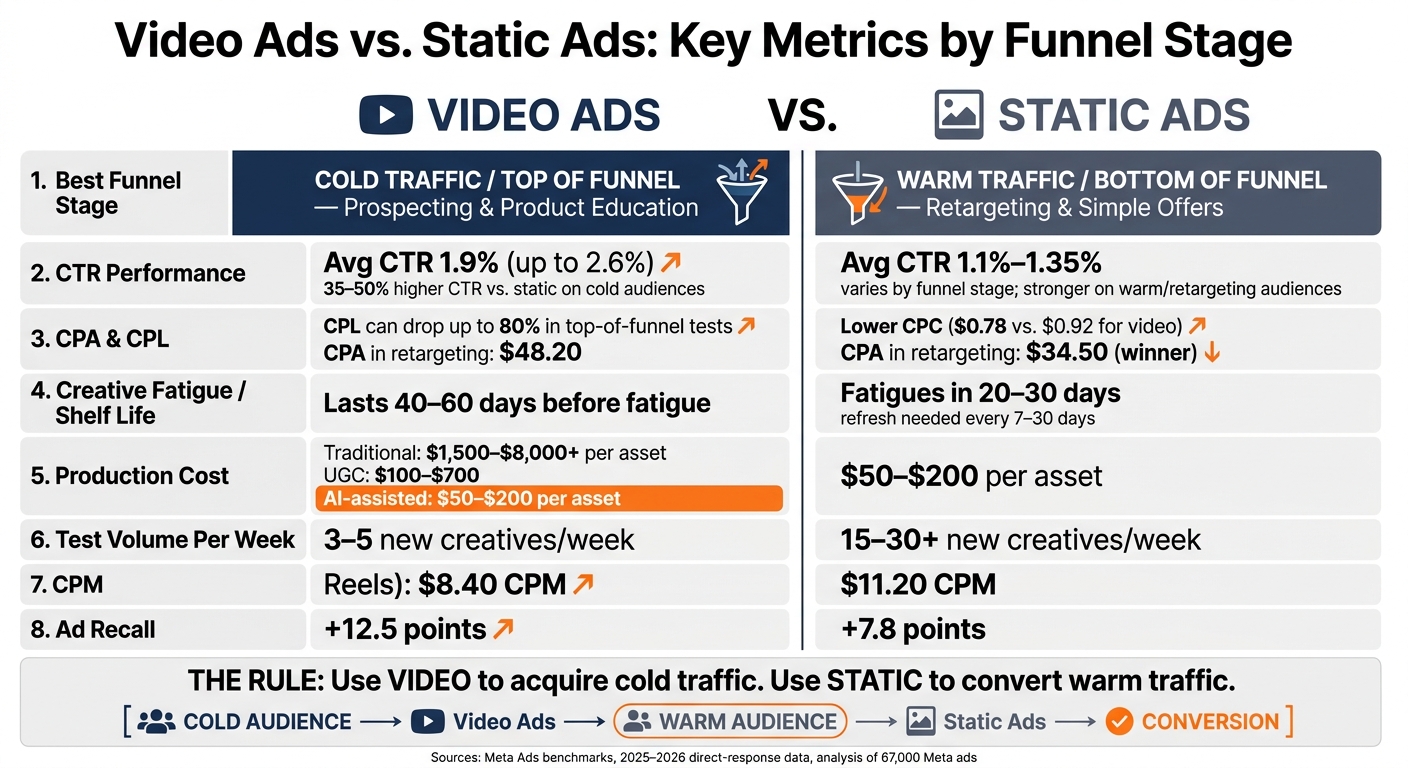
Video Ads vs. Static Ads: Key Metrics by Funnel Stage
Why Everyone's Wrong About Video vs Static Ads on Meta
sbb-itb-f51e864
Quick Comparison
| Format | Best use | Main upside | Main downside |
|---|---|---|---|
| Video ads | Cold traffic, product education, higher-consideration offers | Higher CTR, more room to explain, longer shelf life | Higher cost, more production work |
| Static ads | Retargeting, simple offers, fast testing | Lower cost, clear message fast, easier to test at volume | Shorter shelf life, less room to explain |
So no, video does not win every time. The better format depends on where the person is in the funnel, what you sell, and how many new assets your team can ship each week.
1. Video Ads
CTR and CPL Performance
Video ads tend to beat static ads on click-through rate. In Meta ads, video averages a 1.9% CTR versus 1.1% for static. Some benchmarks put video CTR as high as 2.6%.
At the top of the funnel, that edge can mean 35%–50% higher CTRs. That’s a big deal when you’re trying to get cold traffic to stop scrolling.
The CPL difference comes from the way Meta’s auction system rewards engagement. More watch time and stronger interaction can help delivery and push CPL down. For considered purchases and products that need a bit of explaining, video often does a better job of turning attention into leads.
Funnel Fit
Video is a strong fit for cold audiences. It can show the product, explain the offer, and give people context in 15–30 seconds. A single image usually can’t do all of that, especially when the brand is new to the viewer.
For higher-consideration purchases, video can expand ROAS on prospecting campaigns by 30%–50%. But there’s a catch: for impulse buys under $30, static and video perform about the same.
Fatigue and Refresh Cadence
Static ads usually fatigue in 20–30 days. Video often lasts 40–60 days before performance starts to slip.
That longer runway is one reason video works so well for acquisition. Static, on the other hand, often makes more sense for fast retargeting tests where speed matters more than depth.
Production Cost
The trade-off is cost.
- A static ad usually runs $50–$200 per asset
- A UGC video usually runs $100–$700
- Professional video production can hit $1,500–$8,000+ per asset
That price gap is exactly why AI changes the math later in this article. Lower cost per asset matters most when you need to refresh ads often. Static ads still have the edge in some lower-funnel cases.
2. Static Ads
CTR and CPL Performance
Static ads usually struggle more with cold traffic, but they often do better once people already know the brand. Video can grab attention first. Static can win later, especially when the offer is simple and easy to grasp.
Some 2026 direct-response benchmarks show exactly that. Image ads posted a higher average CTR of 1.35% than video at 1.10%. They also came with a lower average CPC of $0.78 versus $0.92 for video, plus a lower average CPA of $15.20 versus $16.80.
Why does that happen? A strong static ad can get the point across in less than a second. Video asks for more attention, and cold audiences often don't give you that time.
Funnel Fit
Static ads tend to work best at the bottom of the funnel, especially for retargeting. Once someone knows your brand, they usually don't need a long story. They need a clear deal, a sharp product shot, or one good reason to click.
The numbers back that up. In retargeting-heavy campaigns, static ads delivered a $34.50 CPA compared with $48.20 for video. And in a 2025 analysis of 67,000 Meta ads, the median account ran 61% static and 39% video.
That split says a lot. Marketers aren't leaning on static by accident.
Fatigue and Refresh Cadence
Static ads burn out faster than video, so they need to be refreshed more often. If you're running the same image too long, performance can slip fast.
Watch frequency closely. Results often start to fall once a creative reaches 2.5–3.0 frequency.
Production Cost
Static's biggest edge is speed. It's faster to make, easier to swap, and much cheaper to test at volume.
That matters when you're trying to test lots of ideas or stay ahead of fatigue. Rotating 20 variants costs a small slice of what the same test would cost in UGC video. For visually driven, low-consideration products, static images can match or beat video. And for premium products like jewelry and home decor, high-resolution photography can do a lot of the selling on its own.
That funnel split is the real rule: video for acquisition, static for retargeting.
Pros and Cons
Use this matrix to pick the right format based on funnel stage, how fast your team can ship new creative, and how much production work you can handle.
| Format | Pros | Cons |
|---|---|---|
| Video Ads | Higher CTR (1.5–2.6%); stronger ad recall (+12.5 points vs. +7.8 for static); lower CPMs in Reels ($8.40 vs. $11.20); a better fit for complex products that need demonstration, storytelling, or emotional pull | Slower and more expensive to produce ($300–$2,000+ per asset); harder to isolate whether the script, creator, or edit drove results; many variants miss the mark, so test volume matters |
| Static Ads | Faster to produce (hours to days); lower CPA in retargeting ($34.50 vs. $48.20 for video); clear at a glance; cheaper to test at scale ($50–$200 per asset) | Fatigues 30–50% faster than video; less room for storytelling; weaker fit in video-first placements like Reels and Stories |
What matters next is refresh rate. A format can look great on paper, but if it burns out fast, your team has to keep the machine fed.
Creative Fatigue and Velocity
Shelf life changes the workload in a big way. Video usually keeps performing for 40–60 days, while static often starts to slip after 20–30 days.
| Feature | Static Ads | Video Ads |
|---|---|---|
| Production Speed | Fast to produce | Slower to produce |
| Asset Refresh Needs | High - every 7–30 days | Moderate - every 30–60 days |
| Messaging Clarity | Clear in a single glance | Sequential; needs 15–30 seconds of attention |
| Test volume | High - 15–30+ new ads per week | Low - 3–5 new ads per week |
That’s the tradeoff in plain English: static is easier to make and test in bulk, but it tends to wear out sooner. Video takes more time and money up front, yet it often gives you a longer runway before performance starts to dip.
The next question is whether video’s stronger results can be produced at a cost that scales.
How AI Changes the Cost of Video Production
AI matters because it shrinks the gap between video's upside and static's lower production cost. In the old model, video production often costs $2,500–$15,000 per asset and takes 2–4 weeks, which makes paid social refresh cycles tough to keep up with.
With an AI video pipeline, teams can automate scripting, editing, captions, hook swaps, and exports. That can bring production down to about $50–$200 per asset, while turnaround drops from weeks to hours or days.
That shift changes what teams can actually do. One core idea can turn into several versions with different hooks, music, and text overlays. And that helps fight creative fatigue head-on. Lower costs also make room for a lot more testing, with some teams able to launch 5–12 new creatives weekly - a level that used to be out of reach for many small-to-mid-size teams.
So the creative mix starts to shift. Video becomes much easier to keep in motion, while static still holds its place in retargeting. AI cuts video costs, but it doesn't erase static's edge when teams need fast retargeting. The result is simple: the video-heavy part of the funnel becomes far easier to maintain at roughly the same pace as static creative.
Conclusion
The rule is simple: use video to bring in cold traffic, and use static to close warm traffic. This isn’t about format vs. format. It’s about funnel stage vs. funnel stage.
That only works if you judge each asset by the right metric at the right stage. Don’t judge all creative on one number. CTR, CPL, CVR, and ROAS each tell a different story.
A video with a higher CPM can still win in prospecting. A static ad with a lower CTR can still win in retargeting. After that, your production capacity shapes how often you can refresh each format.
Lower-spend accounts usually need more static for low-cost testing. Higher-spend accounts can support a heavier video mix. AI shifts that balance in a direct way: when production costs drop, video can be refreshed at a pace that used to be possible only with static.
The real test is simple: does your weekly creative output match what each funnel stage needs? The FAQ below breaks down how to pick the right mix based on budget, funnel stage, and creative volume.
FAQs
How much should I spend on video vs. static ads?
For mature Meta advertisers spending $30,000+ per month, a common split is 60–70% video and 30–40% static.
Use video for cold prospecting and awareness. It’s often the best fit for reaching new people and making a strong first impression.
Use static for retargeting, where it often drives 20–30% lower cost per acquisition.
If you're spending under $20,000 per month, start with static. It’s a fast, lower-cost way to test hooks and messaging. Then take the winners and turn them into video.
When should I switch from video to static in the funnel?
Switch to static ads in the bottom-of-funnel and retargeting stages. Video is usually better for awareness and discovery. But once people already know your brand, static ads tend to do a better job of turning that interest into action.
For retargeting, static creative works well when prospects need a clear, concise prompt to buy, not a longer story. It can also help lower CPA and takes less time and budget to produce, which makes it easier to keep your creative fresh.
How many new creatives should I launch each week?
Top DTC brands usually aim for 15 to 30 new creatives per week for every $100,000 in monthly ad spend. That pace helps keep customer acquisition costs from creeping up.
Static ads also burn out 30% to 50% faster than video, so they often need to be swapped out more often. A common approach is pretty simple: use static assets to test ideas fast and at scale, then put more time and budget into video after early tests point to winning concepts.
Need video like this for your brand?
UGC, commercials, explainers and cinematic — directed with AI, finished like a studio.
Start a project →