Sora vs Veo vs Kling: Which AI Video Tool Is Best for Brand Ads? (2026)
If I had to sum it up in one line: Veo 3.1 is best for polished ad shots, Kling 3.0 is best for cheap testing at scale, and Sora 2 is not a safe long-term pick in 2026.
That’s the short answer most brand teams need.
If I’m choosing for ads today, I care about six things: video quality, prompt control, use case fit, output consistency, cost, and access. And the numbers matter. Veo runs about $0.15 to $0.40 per second, while Kling is about $0.10 per second. That gap adds up fast when I’m testing 20 to 30 clips for paid social.
Here’s the plain-English takeaway:
- Use Veo 3.1 for product shots, hero ads, and scenes where realism matters
- Use Kling 3.0 for high clip volume, hook tests, UGC-style ads, and local variants
- Avoid building around Sora 2 because its product shutdown dates make it a weak fit for an ad pipeline
- Don’t judge by model name alone because briefing, shot design, editing, color, audio, and resizing often decide whether the ad is ready to run
A raw AI clip is still just a draft. In most cases, teams still need storyboards, prompt work, post-production, aspect-ratio cutdowns, and finishing before the ad is ready for 9:16, 1:1, 16:9, or CTV placements.
So the best tool is not the one that “wins.” It’s the one that fits the shot, budget, and deadline.
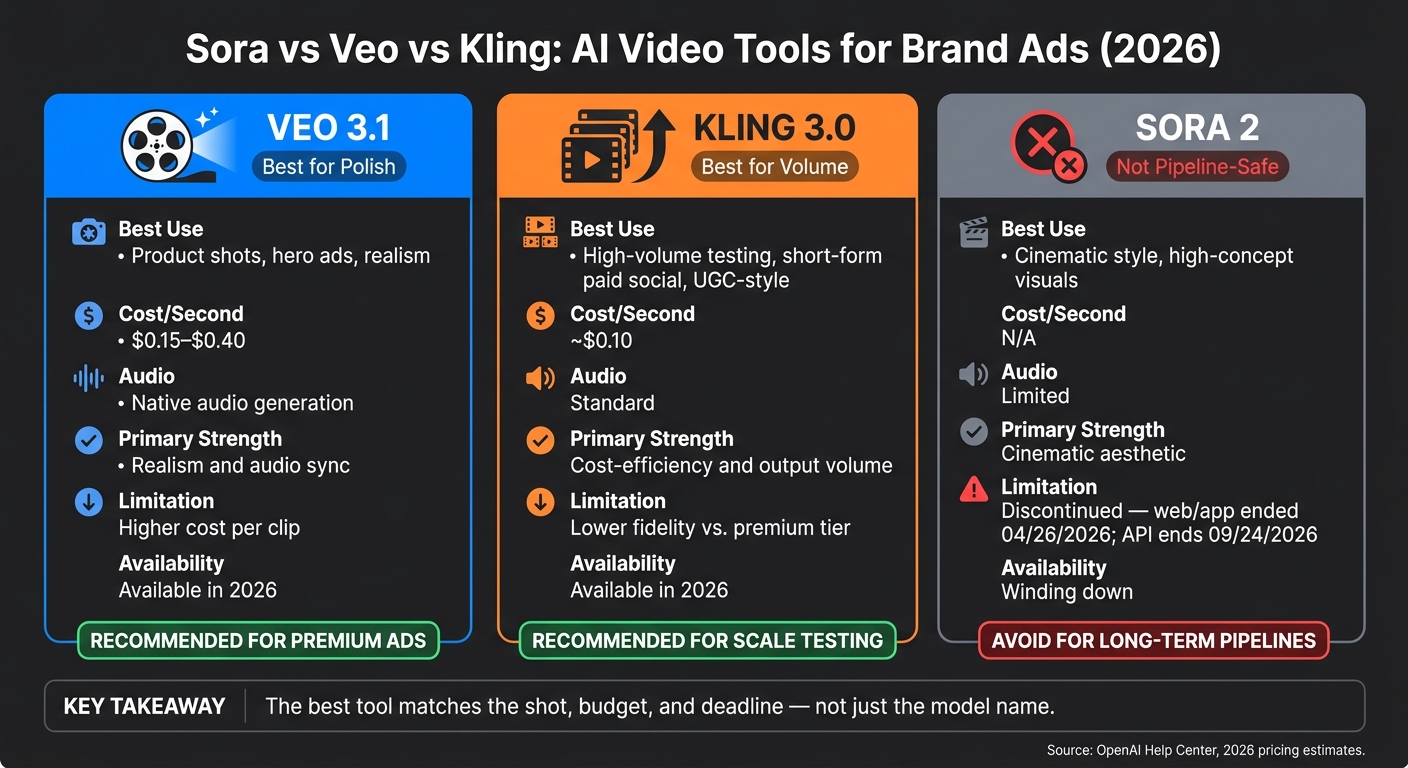
Sora vs Veo vs Kling: AI Video Tool Comparison for Brand Ads (2026)
Kling 3.0 vs Sora 2 vs VEO 3.1: AI Video Generator Battle (Clear Winner)
sbb-itb-f51e864
Quick Comparison
| Criteria | Veo 3.1 | Kling 3.0 | Sora 2 |
|---|---|---|---|
| Best fit | Product shots, hero ads, realism | Paid social testing, short-form volume | Cinematic concept visuals |
| Cost per second | $0.15–$0.40 | About $0.10 | N/A |
| Audio | Native audio generation | Standard | Limited |
| Main strength | Realism and audio sync | Low-cost output at scale | Film-like look |
| Main drawback | Higher clip cost | Lower detail than top tier tools | Discontinued / shutting down |
| Availability in 2026 | Available | Available | Web/app ended 04/26/2026; API ends 09/24/2026 |
If I were picking fast, I’d use this rule:
- Veo = polish
- Kling = volume
- Sora = style, but not pipeline
That’s the core answer this comparison supports.
The 2026 AI Video Landscape for Brand Ads
By 2026, AI video was ready for many brand-ad jobs. The big step forward came from better motion, stronger physics, and more stable shot-to-shot consistency. For brand ads, the smart question isn't which model looks best on its own. It's which one matches the shot, the budget, and the way your team plans to produce.
That change split the market into three clear lanes: one tool for realism, one for volume, and one for style.
Where Veo 3.1, Kling 3.0, and Sora Fit in the Market
Three tools lead most of the discussion right now, and each has its own role.
Veo 3.1 is the realism pick. It creates audio with the video, which makes it the strongest option for product shots and hero ads where polished output matters. The tradeoff is simple: each clip costs more.
Kling 3.0 is the volume option. It's built for teams that need lots of clips at a low cost, especially for short-form paid social where scale testing is the whole game. It doesn't match Veo on realism, but its cost per second is tough to beat.
Sora 2 leans into a cinematic look and can work well for high-concept visuals. But there's a catch. Per OpenAI's Help Center, the Sora web and app experiences were discontinued on April 26, 2026, and the Sora API will be discontinued on September 24, 2026. That makes it a weak base for an active ad pipeline.
For teams running ads every week, access and reliability matter more than looks alone.
Quick Comparison: Quality, Cost, Speed, and Availability
Here's the fastest way to tell them apart.
| Feature | Veo 3.1 | Kling 3.0 | Sora 2 |
|---|---|---|---|
| Best Use Case | Product shots, hero ads, realism | High-volume testing, short-form paid social | Cinematic style, high-concept visuals |
| Approx. Cost/Sec | $0.15–$0.40 | ~$0.10 | N/A |
| Audio Support | Native audio generation | Standard | Limited |
| Primary Strength | Realism and audio sync | Cost-efficiency and output volume | Cinematic aesthetic |
| Limitations | Higher cost per clip | Lower fidelity vs. premium tier | Discontinued / no durable pipeline value |
| Current Availability | Widely available | Widely available | Discontinued / winding down |
That price gap matters when teams are testing ad creative at scale.
Sora vs Veo vs Kling: Which Tool Works Best for Different Ad Jobs
The landscape section mapped out the options. This is the part that matters when you have a brief, a deadline, and a budget staring back at you.
Veo 3.1 for Premium Realism, Product Shots, and Hero Ads
Veo 3.1 is the best pick for premium realism. Liquids pour the way you’d expect. Fabrics move with proper weight. Lighting stays steady even when you look closely. And for a hero ad, that stuff matters.
If the product needs to look flawless on screen, Veo has the edge. Think of a skincare brand showing the texture of a serum, or a beverage brand pouring over ice. Those are the kinds of shots where Veo stands out.
The synced audio workflow also removes one step from finishing, which can save time. That said, longer sequences still need clip stitching in post, so you’ll want to leave room for editing. Cost is the trade-off here: at $0.15 to $0.40 per second, Veo is the most expensive option.
That edge shows up most when the shot lives or dies on realism and clean finishing.
Kling 3.0 for Affordable Testing Volume and Short-Form Paid Social
If you're running hook tests or churning through paid social ideas, Kling 3.0 is the practical workhorse. At about $0.10 per second, it keeps testing costs under control.
That price point changes the math. You can make 20 or 30 versions of a concept without burning through the budget before you even know what works. For performance teams, that’s a big deal.
Kling also does a good job with localized variants and keeping a steady visual style across many assets. It won’t match Veo on fine material detail, but that’s not always the job. For UGC-style content and fast-moving social ads, Kling fits well.
So Kling makes more sense for testing at scale than for a single polished spot.
Sora 2 for Cinematic Style, but Not a Long-Term Ad Pipeline
Sora 2 has a cinematic look that works well for concept-led visuals. The style is there. The issue is access and shelf life.
OpenAI says:
"The Sora web and app experiences were discontinued on April 26, 2026. The Sora API will be discontinued on September 24, 2026."
That puts Sora in a tough spot for advertisers. It’s a discontinued product, not something you’d want to build a long-term brand pipeline around.
Which brings the next production issue into focus: how much direction the shot needs, and how much cleanup happens in post.
Tool choice matters. But the workflow around the tool matters more. The next question isn’t just which model you pick. It’s how you direct the shot and finish the output.
Why the Tool Is Not the Hard Part
Choosing Veo over Kling - or sending a shot through one model instead of another - is only one piece of the work. What happens before and after generation matters just as much.
Direction, Shot Design, and Finishing Decide Whether the Ad Converts
This is where the job actually begins: turning model output into an ad you can ship.
A raw AI clip is not a finished ad. It needs a tight brief, script, storyboard, and prompt design that spell out lighting, lens, motion, pacing, and mood. Without that setup, the model you pick matters a lot less.
Then comes finishing: color, sound, pacing, and cutdowns for 16:9, 9:16, square, and CTV. That’s the part that makes the piece ad-ready.
The right model helps. But the brief and the finish decide whether the ad is usable. That’s why the best AI video generator for ads depends on the shot, not the name on the tool.
Why an Expert Who Runs All These Tools Beats Betting on One
The smart move isn’t picking one favorite model and forcing every shot through it. It’s using each model for the job it does best and routing the shot that way.
That’s the idea behind a tool-agnostic, production-first approach: concept, generation, editing, and finishing all sit in the same pipeline, and the model is just one step. Even a strong model can’t save a weak brief, weak prompts, or weak finishing.
Supporting Tools in a Real Ad Workflow
A real ad workflow pairs generation with editing, color, audio, and versioning tools.
- Generation handles the raw visual output
- Editing shapes the story and timing
- Color helps the footage feel polished and on-brand
- Audio adds punch, clarity, and mood
- Versioning gets the ad ready for each placement
The generator is only one part of the pipeline. The support stack is what gets the output ready to ship.
Conclusion: The Best AI Video Generator for Ads Depends on the Shot
There’s no single winner here. Veo 3.1 works best for premium realism, Kling 3.0 makes more sense for high-volume testing, and Sora 2 is no longer a durable pick for ad production. But the bigger edge doesn’t come from the model name alone. It comes from how the shot is directed, refined, and finished.
In practice, the strongest result usually comes from matching the model to the shot first, then polishing the output for color, sound, and delivery. Put simply: the workflow matters more than the label on the tool.
Model specs, pricing, and access can change fast in 2026. It’s smart to double-check the latest details before you choose a tool.
For a deeper workflow breakdown, read these related guides: how AI video direction works in practice, what a finished AI ad actually requires, and how to brief AI video for paid social.
FAQs
How much post-production do AI ad clips still need?
Usually, a lot of post-production.
AI video tools are a strong starting point, but they almost never spit out a polished brand ad in one pass.
You’ll still need color grading, sound design, and story editing to make the piece feel like your brand. AI can speed up the process and give you raw material fast, but human polish is still what turns rough clips into a finished ad.
When should I choose Veo over Kling for a campaign?
Choose Veo when your budget can handle the higher price: about $0.15–$0.40 per second, compared with Kling at about $0.10 per second.
That said, the best pick shouldn't come from a fixed favorite. It should come from expert testing of both tools. These platforms change fast, and stronger campaigns often come from using more than one generator in the right places.
Is Sora still worth using for ad work in 2026?
No. Per OpenAI's Help Center, Sora's web and app experiences ended on April 26, 2026, and the API will be discontinued on September 24, 2026.
Because it's being phased out, it isn't a viable option for ad work in 2026.
Need video like this for your brand?
UGC, commercials, explainers and cinematic — directed with AI, finished like a studio.
Start a project →