How to Scale Ad Creatives Without Blowing Your Budget

If your ads burn out in 5–14 days, the fix is not just more spend. It’s a better testing pace, a set test budget, and a faster way to ship new ads.
I’d sum the article up like this: if only about 5% of new Meta ads turn into winners, I need to launch more ads each week, protect spend for ads that already work, and cut losers fast. For most brands, that means putting 10%–18% of spend into testing, giving each concept about $150–$300 over 3–5 days, and not making calls before enough data comes in.
Here’s the full point in plain English:
- Ad fatigue is hitting sooner. In many cases, ad life has dropped to 5–8 days.
- More output leads to more winners. Mid-size top accounts ship about 16 ads per week.
- Most spend should stay on proven ads. About 55% of spend goes to winners.
- Testing needs rules. Check one variable at a time, use spend floors, and set clear cut/scale limits.
- Production is often the choke point. AI can cut cost per asset from $400–$800 to about $2–$8 per render and cut turnaround from 7–14 days to minutes.
A short way to think about it: don’t try to win with one polished ad. I’d win by building a repeatable system for angles, hooks, variants, budget limits, and production speed.
That’s the core idea of the article.
The Best AI Ad Creative Strategy for 2026
sbb-itb-f51e864
Why Creative Is the Main Performance Lever Now
Bid adjustments and audience tweaks still matter. But they’re not the main lever anymore.
Creative now has a bigger impact on delivery, which means hooks, visuals, and copy matter more than manual audience tweaks. For MOFU brands, that turns creative throughput into a performance variable, not just a branding task.
Creative quality drives 56% of digital sales ROI, which is more than media or targeting.
So the question isn’t, “Should we invest in creative?” It’s: Are we making enough of it, and are we making it fast enough?
Short Fatigue Windows and the Case for More Tests
In crowded categories, creative lifespan has shrunk from about 14 days in 2022 to 5–8 days in 2026. And the frequency data makes the problem plain.
At a frequency of 4, CTR drops 23.34% and CPC rises 68.02%. At 9, CTR falls 49.87% and CPC jumps 161.15%.
That kind of fatigue changes how you think about scale. It’s not just about finding one good ad and riding it out. That window closes fast.
With only a 5% hit rate for winners on Meta, the answer is more testing - but not random volume. You need a system. A repeatable way to ship more concepts, learn faster, and give yourself more chances to land on ads that can scale.
What Lower-CAC Creative Actually Changes
Creative that lowers CAC doesn’t come from a bigger production budget. It comes from better messaging, sharper hooks, and faster iteration.
The ads that cut CAC usually do one thing better than the rest: they stop the scroll and answer the question, “Why does this matter to me?” right away.
In most cases, the concept matters more than polish. What separates top-performing ads is the angle, the exact problem they speak to, and how the hook is framed. That’s why top-performing accounts don’t just spend more on production - they give themselves more chances to find the concept that clicks, on identical spend.
Next, set the weekly creative target and budget split that keeps testing moving without starving proven winners.
Creative Velocity Benchmarks and Budget Guardrails
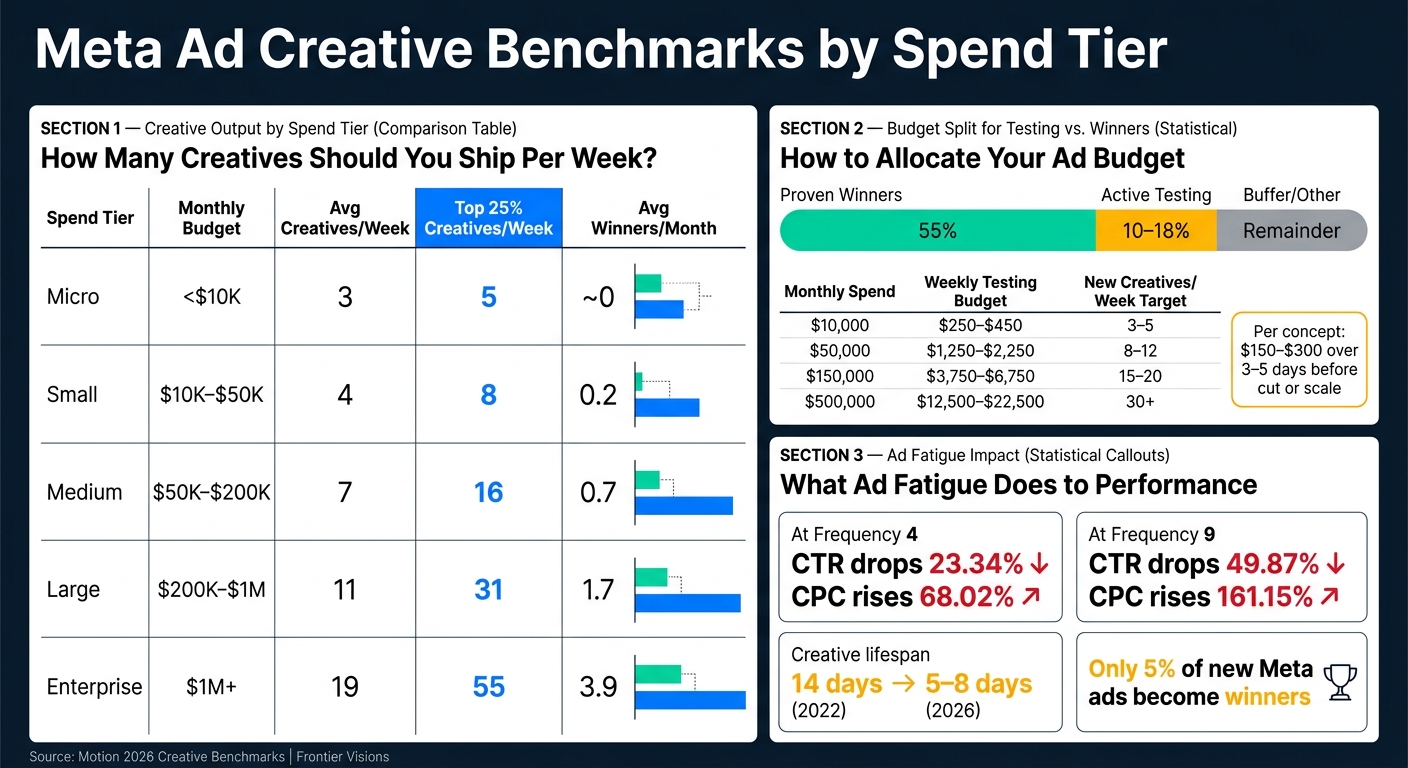
Meta Ad Creative Benchmarks: Output, Budget & Fatigue by Spend Tier
If creative is the main lever, these benchmarks show how much output it takes to make that lever work. They also connect straight to the 10–14 day fatigue window: the point isn't pumping out assets just to stay busy. It's shipping enough new creative to swap in before tired ads push CAC up. Bigger accounts don't find better winners by magic; they simply test more often.
How Many Creatives to Ship Each Week
The gap between average accounts and top performers mostly comes down to volume.
Top-quartile mid-size brands spending $50K–$200K/month ship about 16 creatives per week. Enterprise accounts spending $1M+/month ship 55 creatives per week in the top quartile, compared with 19 for the average enterprise account.
| Monthly Spend | Average Creatives/Week | Top 25% Creatives/Week | Avg. Winners/Month |
|---|---|---|---|
| Micro (<$10K) | 3 | 5 | ~0.0 |
| Small ($10K–$50K) | 4 | 8 | 0.2 |
| Medium ($50K–$200K) | 7 | 16 | 0.7 |
| Large ($200K–$1M) | 11 | 31 | 1.7 |
| Enterprise ($1M+) | 19 | 55 | 3.9 |
Source: Motion 2026 Creative Benchmarks [8][10]
The pattern is pretty clear: more output leads to more winners. Treat these figures as a weekly production target, then decide which angles are worth funding.
How to Split Budget Between Testing and Proven Winners
Across the dataset, about 55% of total Meta ad spend goes to winning creatives. That's a smart concentration. If too much budget gets pulled into testing, proven ads lose the spend they need to keep carrying performance.
A practical range is to set aside 10%–18% of total spend for testing.
In dollar terms, here's what that looks like:
| Monthly Total Spend | Weekly Testing Budget | Target New Creatives/Week |
|---|---|---|
| $10,000 | $250–$450 | 3–5 |
| $50,000 | $1,250–$2,250 | 8–12 |
| $150,000 | $3,750–$6,750 | 15–20 |
| $500,000 | $12,500–$22,500 | 30+ |
Per concept, plan $150–$300 over 3–5 days before you cut it or scale it.
Once that cap is set, the next move is deciding what to test first.
Build a Lean Testing System With Clear Kill and Scale Rules
Once you know your weekly production target, the next step is putting a system around it. Test one variable at a time so each result points to one clear cause. That’s how you keep testing from turning into wasted spend. Start with a single variable, then set the rule for what happens next.
Test Angles, Hooks, and Variants in Order
Test one variable at a time: angle, hook, treatment, or format. If you see high CTR but low CVR, that usually means the hook did its job, but the message or angle didn’t carry the ad the rest of the way.
Use refreshes to keep a known winner going. Use rebuilds to look for new hooks. A refresh keeps the winning hook and swaps pieces like the background or B-roll. A rebuild changes the hook and the core concept. That split helps protect spend while keeping learning moving.
Once you isolate the variable, measure it inside a fixed window before you kill it or move it into scale.
Set Minimum Data Windows Before Making Decisions
Don’t judge a concept before it reaches a $500 spend floor. Below that, there just isn’t enough data to trust.
If you’re deciding whether to move an ad into scale, use these thresholds as a guide:
| Metric | Threshold to Scale |
|---|---|
| In-platform ROAS | ≥ 80% of current winner |
| CPA | ≤ 110% of current winner |
| CTR | Top half of the current test set |
| Conversions | At least 2 events in test window |
Source: Frontier Visions [6]
When a winner shows up, scale it by no more than 30% per day to avoid CPM spikes from the auction. On the other side, watch the 7-day trailing CTR. If it falls below 70% of first-week CTR, the ad is wearing out. At 55%, pull it.
Log Every Test So Each Round Builds on the Last
After you make the call, log the result. Keep a record of each concept’s brief, assets, result, and next action.
Tag hooks by archetype - Problem Agitation, Founder Origin, Social Proof - and track what each one brings back. Over time, that turns into a hook library you can use when briefing new tests. Review that archive on a fixed cadence so each round starts from what you’ve already learned instead of from zero.
Even when the full ad misses, one piece of it can still earn its keep. A testimonial block, for example, may still deserve a spot in the next round.
Remove the Production Bottleneck With AI
Why Production Delays Slow Down Scaling Before Strategy Does
Once your testing rules are set, the bottleneck usually moves from strategy to production speed. Most teams don’t run out of ideas. They run out of capacity. Briefs get stuck, edits take too long, and the next ad shows up after the current winner has already worn out.
Forty-one percent of marketers need three to four weeks to launch a campaign, while only 3.6% ship in under a week. And the warning sign is pretty clear: winning ads hit frequency 3.0+, then performance starts to slip before the replacement is ready.
Once a creative clears the scale threshold, the job changes. Now it’s about replacing that winner before results fall off.
How AI Helps Teams Ship More Ad Creative for Less
When production can’t keep up with fatigue, AI stops being just a cost play. It becomes a workflow fix. Put simply: the answer is a faster way to produce.
AI can split one concept into reusable parts, like the hook, body, and CTA. That means one body can turn into dozens of test-ready variants.
The cost gap is hard to ignore. Traditional UGC from a mid-tier creator runs $400–$800 per asset with a 7–14 day turnaround. An AI pipeline cuts that to about $2–$8 per render in under 10 minutes. So instead of waiting around, teams can test more concepts before fatigue sets in.
AI also takes care of the production tasks that quietly slow everything down:
- Reformatting for 9:16 and 1:1
- Applying naming conventions
- Generating UTMs for each placement
That gives your strategist more time for the work that still needs human judgment: reading results and deciding what to test next.
At that point, the limit isn’t ideas anymore. It’s how fast you can turn winners into new tests. For teams spending $50,000–$200,000 per month, producing fewer than 16 creatives a week is a bottleneck.
FAQs
How do I know if my ad is fatigued or just needs more time?
Don’t go with gut feel here - look at frequency and spend first.
Ad fatigue is tied more to frequency than to time. So instead of swapping an ad out just because a few days have passed, wait until user frequency hits around 2.5–3.0 before you call it fatigued.
If the ad hasn’t reached that range yet, give it a little room. Let it run for 48–72 hours and spend at least $50–$100 before you judge performance.
It also helps to sanity-check the numbers from two angles:
- See whether costs have doubled compared with the ad’s past average
- Compare results against your account median, not just that ad’s own past data
That second point matters more than it seems. An ad can look fine compared with its own history and still be underperforming when stacked against the rest of the account.
What should I test first if I have a small budget?
Put your testing focus on core ideas, not tiny design tweaks. Changing a button color usually won’t tell you much. Testing a different hook, a new value proposition, or a sharper messaging angle will.
Keep your tests limited and clean so each creative gets enough spend to produce a meaningful read. The goal is to find a winner fast. Cut the losers just as fast, using objective data instead of gut feeling.
How many new creatives do I really need each week?
Base your weekly testing volume on your spend tier, not on one blanket goal for everyone.
In 2026, the average number of tests run per week looked like this:
- Micro: 2.8
- Small: 4.1
- Medium: 6.6
- Large: 11.2
- Enterprise: 18.8
That gap matters. A Micro account and an Enterprise account are playing very different games, so they shouldn’t be held to the same weekly target.
There’s another reason volume matters so much: winners are rare. Only about 1 in 10 to 1 in 13 tests turns into a winner. So if you want better odds, the biggest lever is simple - run more tests.
That’s exactly what top-quartile brands do. They test 2 to 3 times more than the average for their tier, which gives them more chances to find the few ideas that break through.
Need video like this for your brand?
UGC, commercials, explainers and cinematic — directed with AI, finished like a studio.
Start a project →