How to Lower CAC With Better Video Ad Creative

If your CAC is up, the ad itself is often the first place I’d look. For many DTC brands, CAC has climbed 25%–40% as auctions get crowded and CPMs climb. And in 2026, audience targeting does less than it used to, so video has more impact on what happens next.
Here’s the short version:
- I’d focus on hooks, offers, and conversion cues
- I’d judge video by lead quality, not just clicks
- I’d watch Lead-to-MQL, Lead-to-SQL, and sales velocity
- I’d test testimonials, demos, and comparison videos
- I’d check whether the problem is the ad, landing page, or offer before making more ads
- I’d swap in new variants before frequency and CPMs climb too far
In other words: lower CAC usually comes from video that pre-qualifies people, cuts weak clicks, and helps more paid traffic turn into buyers. The goal isn’t more traffic. The goal is better traffic that moves through the funnel at a lower cost.
Here's How To Lower Your Facebook Ads CAC By 50%
sbb-itb-f51e864
What drives CAC for DTC brands right now
DTC CAC is up 25%–40% as ad auctions get more crowded and media costs keep climbing. At the same time, targeting has less impact on CAC than it used to. Creative now moves CAC more than targeting does.
That puts brands in a tight spot. Margins get squeezed, and payback periods stretch out. So the main lever left to pull is often the ad itself. In plain English: the performance conversation has shifted from who you target to what they see.
Why CAC has climbed as platforms get more crowded
When more brands compete for the same slice of attention, CPMs go up. And when CPMs rise, CPL usually follows. From there, CAC climbs too.
That chain reaction is pretty simple:
- More competition in auctions pushes up CPMs
- Higher CPMs tend to lift CPL
- Higher CPL puts pressure on CAC
Once auctions hit that crowded point, the next issue isn't just reach. It's whether the ad can bring in better leads. If the creative doesn't do that, brands end up paying more for traffic that doesn't convert well.
How MOFU video affects CPL and downstream CAC
As auctions get tighter and targeting does less of the heavy lifting, MOFU video can lower CAC by helping more paid clicks turn into qualified leads.
That matters because better lead quality improves CPL and cuts wasted spend later in the funnel. Instead of paying for clicks that go nowhere, brands have a better shot at moving people from interest to action.
So while top-of-funnel costs may stay high, MOFU video helps control what happens after the click. That's often where downstream CAC starts to improve.
Why creative is the main performance lever in 2026
As auctions get more crowded and targeting loses some of its edge, creative is the variable that still moves CAC. In 2026, it’s the main lever left because platforms optimize delivery based on user response signals, not just audience settings. For DTC brands, stronger video gives the system better signals, which can improve CAC by helping the platform find and deliver to qualified leads more efficiently.
How better creative improves auction performance
When video wins attention and drives stronger downstream action, it helps the platform find lower-cost, higher-intent delivery. The audience can stay the same, but the response changes. That shift usually shows up first in delivery efficiency, then in CAC.
How creative fatigue raises CPM and CAC
Fatigue starts when the same ad shows up too often. Frequency goes up, engagement drops, and CPMs start to climb. Fresh video helps keep delivery efficient and prevents CAC from creeping higher.
How video lowers CAC through better leads and more efficient conversion
After auction efficiency, the next CAC lever is what happens after the click. In MOFU, video can lower CAC by improving lead quality, not just by driving more clicks. That’s the key difference. Better creative shouldn’t be judged by traffic alone. It should be judged by whether it brings in leads that are more likely to buy.
Why video can lower CPL
Video keeps people’s attention longer than static ads. That gives you more time to handle objections, show who the product is for, and signal fit before someone clicks. In plain English, the ad does some of the filtering upfront.
That pre-qualification often leads to higher-intent leads, which can lower CPL by improving the share of clicks that turn into conversions.
Watch the numbers that matter:
- Lead-to-MQL
- Lead-to-SQL
- Sales velocity
If those metrics move up and time to closed-won gets shorter, the creative is helping qualify buyers before they ever talk to sales.
Which MOFU video formats tend to reduce CAC
Once lead quality starts to improve, the next step is figuring out which MOFU formats drive that lift most often. At MOFU, the best choice is usually the one that removes hesitation the fastest.
- Testimonial and case study videos tackle objections head-on and build trust with prospects who already know about the product but haven’t said yes yet.
- Demo or explainer videos show the product solving a clear problem, which shortens the evaluation phase and can improve lead-to-SQL rates.
- Comparison or "why us" videos help prospects self-qualify, which filters out lower-intent clicks before they move deeper into the funnel.
Each format lowers friction at the decision stage. And when that happens, you usually see lower CPL and faster sales velocity - both direct inputs to lower CAC.
A step-by-step playbook to lower CAC with video
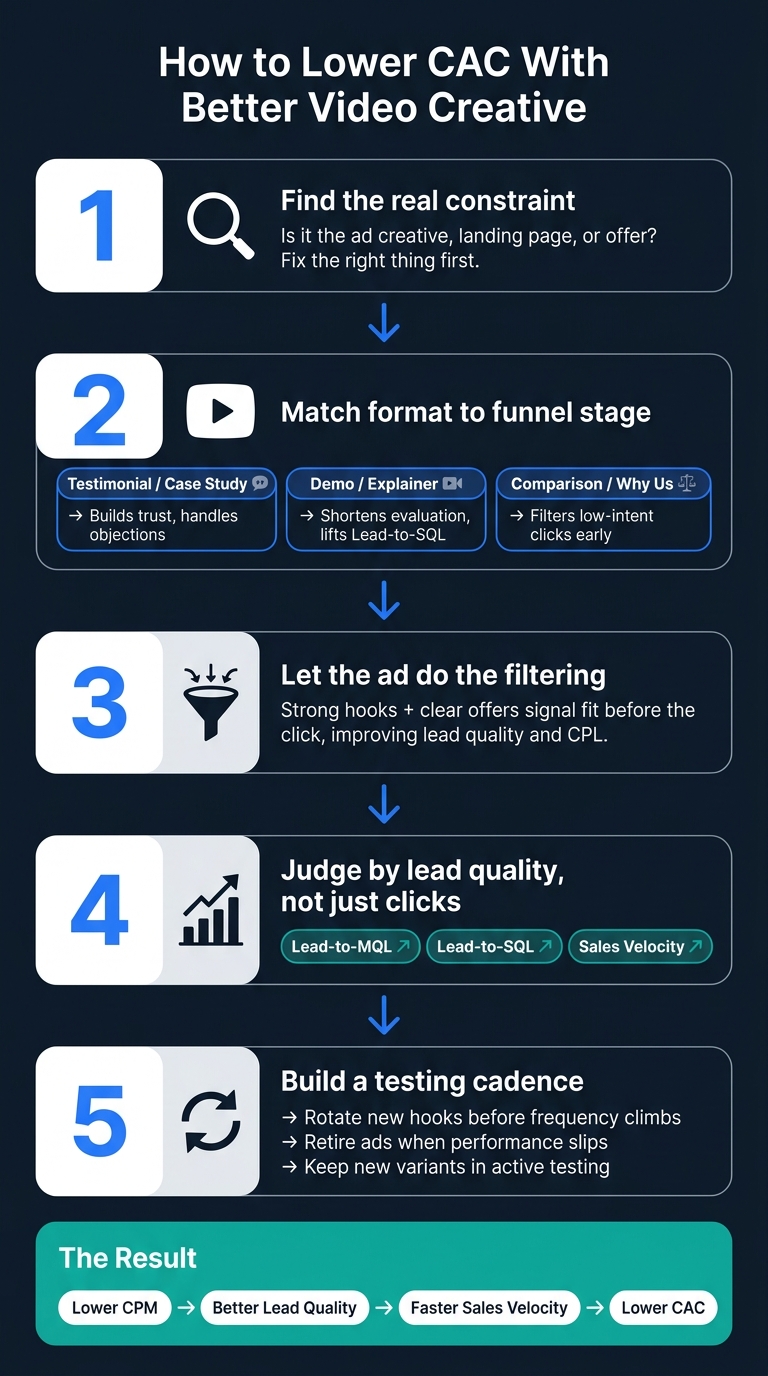
How Video Creative Lowers CAC: A Step-by-Step Funnel Playbook
Winning formats lower CAC only if you refresh them before results start to slip. Start by finding the actual constraint. Then build your production loop around that.
Diagnose the real bottleneck before making more ads
Before you make more ads, check what’s pulling CAC up: the creative, the landing page, or the offer. More volume won’t save a weak post-click path. If the landing page or offer is underperforming, video may help efficiency a bit, but only at the edges.
If creative is the bottleneck, the answer isn’t a one-off refresh. You need a steady testing rhythm.
Build a testing cadence around creative volume and freshness
Fresh creative helps keep delivery efficient and can stop CPM and CAC from creeping upward. Use AI video production to turn one concept into multiple hooks, edits, and aspect ratios in a single workflow. That gives you more to test, faster, without increasing production costs.
A simple loop looks like this:
- Rotate in new hooks before frequency climbs
- Retire ads when performance starts to slip
- Keep new variants in active testing
That’s how you keep the account moving instead of waiting for fatigue to show up first.
Conclusion: Better video creative is the clearest path to lower CAC
Treat video creative like a repeatable growth system, not a one-off campaign. That shift makes it easier to test new ideas, ship new assets faster, and keep your pipeline moving.
Lower CAC with video comes down to three things: fresh creative, faster testing, and better signals to paid platforms. And those three things only work when your production loop keeps going instead of stalling out after one batch of ads.
That’s why production speed matters just as much as strategy. Elizaveta Tskhovrebova offers end-to-end AI video production, with 500+ videos delivered across 36+ brands and a 72-hour average turnaround.
For the deeper framework behind this approach, see Article 10, Article 8, and Article 1.
FAQs
How do I know if CAC issues come from the ad or the landing page?
Compare click-through rate with conversion rate.
If an ad gets a high click-through rate but the landing page has a low conversion rate, the issue is probably the page. People are interested enough to click, but something on the page isn't getting them to take the next step.
If the ad has a low click-through rate, the creative is likely missing the mark. It may not grab attention, or it may not line up with what the audience wants. In that case, focus your optimization on the ad.
What video metrics matter most if clicks look good but sales do not?
If video ads get clicks but not sales, look at the gap between audience interest and your product value proposition. A click can mean the ad caught attention. It does not always mean the offer made sense once people landed on the page.
Focus on hold rate to see if viewers stay past the first few seconds. That tells you whether the video keeps their attention long enough to set up the offer. It also helps you spot whether the message in the ad lines up with the message on your landing page.
Check thumbstop rate too. If that number is strong but users drop off after the click, the ad may be pulling in the wrong crowd. Or the landing page may not be clear enough, specific enough, or in sync with what the video promised.
How often should I refresh video ads to prevent creative fatigue?
There’s no fixed schedule. Refresh video ads when performance starts to slip, not just because the calendar says it’s time.
If results plateau, your audience starts seeing the same ad too often, conversion quality drops, or acquisition costs climb, it’s time to roll out new video variations. Regular testing and fresh creative can help keep CPMs from climbing and your messaging from going stale.
Need video like this for your brand?
UGC, commercials, explainers and cinematic — directed with AI, finished like a studio.
Start a project →