The DTC Founder's Guide to AI Video Marketing in 2026
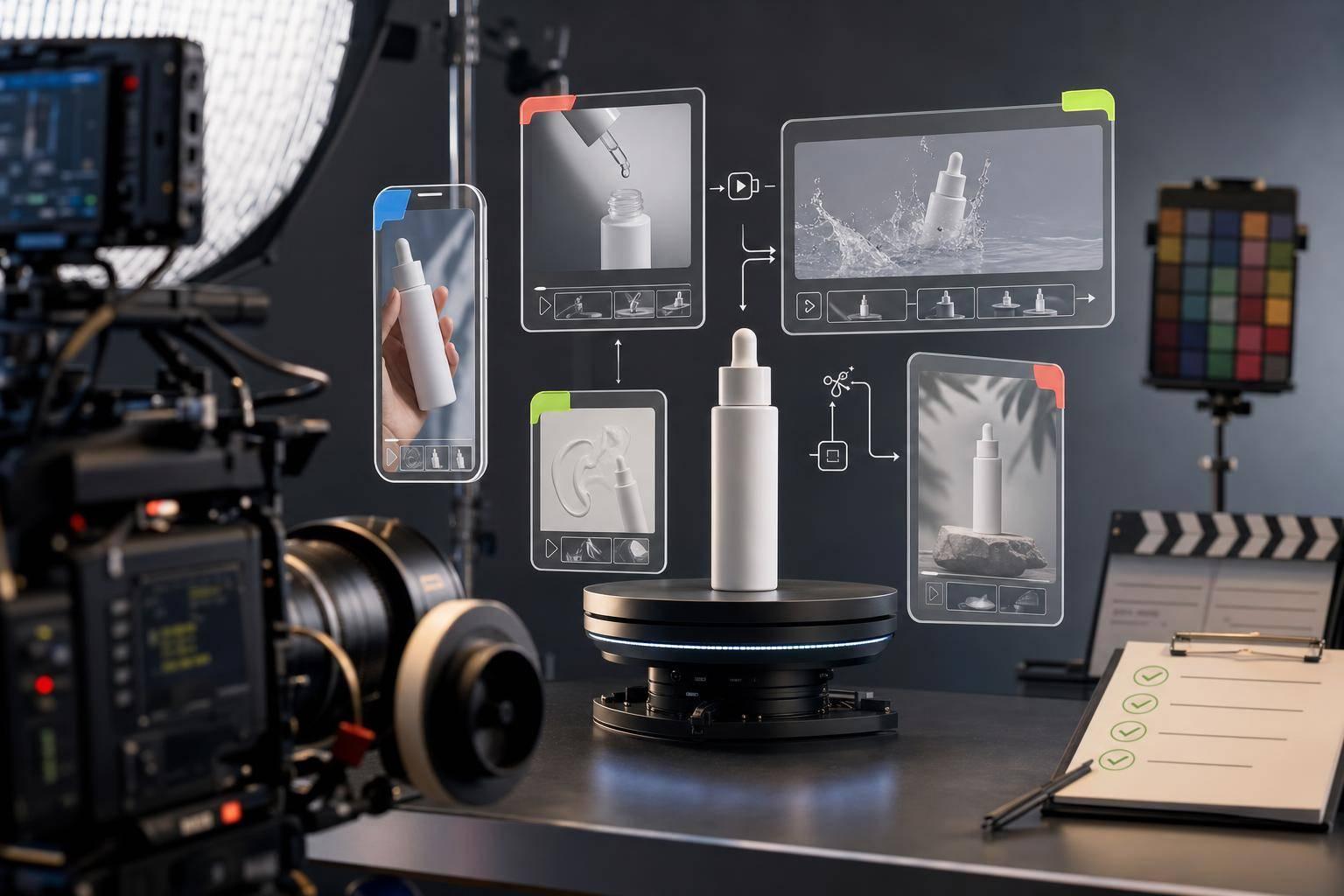
If I run a DTC brand in 2026, I treat AI video as a testing system, not a one-off ad project. Video now drives buying behavior at scale: 91% of businesses use video, 85% of buyers say video helped convince them to purchase, and brands can turn 50 video variations from a cost of $15,000–$100,000 into about $135–$750 with an AI-based workflow.
Here’s the short version:
- Video is now a core sales input, not just a content format.
- The win is volume plus testing, not one “perfect” ad.
- Each funnel stage needs a different video job:
- Top of funnel: stop the scroll
- Middle of funnel: explain the product
- Bottom of funnel: remove buying friction
- Start with simple formats like UGC-style videos and product demos.
- Focus on channels that fit the job: Meta, TikTok, YouTube Shorts, product pages, and email/SMS.
- Use modular production: hooks, body sections, and CTAs as separate parts.
- Watch the right numbers: hook rate, hold rate, add-to-cart rate, CPA, and ROAS.
- Use AI with care: the FTC treats synthetic testimonials as deceptive, with penalties up to $53,088 per violation.
If I had to boil the whole guide down to one point, it’s this: the brands that win are the ones that can make, test, and swap video ads every week without starting from scratch each time.
Quick comparison
| Area | What I’d do |
|---|---|
| Main goal | Build a repeatable video testing system |
| Best first formats | UGC-style talking heads, product demos |
| Best first channels | Meta Reels/Stories, TikTok |
| Top-funnel focus | Hooks and scroll-stopping angles |
| Mid-funnel focus | Demos, reviews, use cases |
| Bottom-funnel focus | FAQs, objections, PDP video |
| Best production setup | Modular assets: hooks + body + CTA |
| Best use of AI | Versioning, editing, testing, backgrounds |
| Use real footage for | Claims, testimonials, product proof |
| First KPI to watch | 25–30% hook rate past 3 seconds |
From there, I’d build one small test around one SKU, one audience, and 5–10 hook variations - then let the data tell me what to make next.
sbb-itb-f51e864
The shift to AI video marketing for DTC brands
What AI video marketing means for ecommerce teams
For ecommerce teams, AI video marketing is a production system, not just one tool. It now helps across the whole workflow: scripting, generation, editing, versioning, and testing.
The biggest change is versioning. Instead of making one final video and calling it done, teams shoot modular parts - a hook, a product demo, a CTA - then use AI to combine those parts into lots of different versions. One shoot can turn into 50+ ad variations.
That changes the day-to-day work. Teams aren’t just making videos anymore. They’re building a repeatable system for testing ideas at scale.
And that only pays off if each video matches its place in the funnel.
Why video wins in 2026
Brands that use video marketing grow revenue 49% faster than those that don’t. On Meta, video ads get 52% more engagement than static ads, and short-form video drives 1.7x higher click-through rates.
That helps explain why video is now a core growth channel, not just another content format.
But those numbers mean little on their own. The format has to match the stage. A strong prospecting ad does a different job than a retargeting ad, and the gap matters.
Why creative velocity matters as much as media spend
Creative velocity is how fast a brand can launch new concepts, variations, and edits each week. In 2026, that matters as much as budget size - and sometimes more.
As ad costs climb, new creative helps protect efficiency. Top advertisers test 15 to 25 new creatives per week, and the gap between a brand’s best and worst hook is often 3x to 5x. AI also cuts turnaround time from 13 days to about 27 minutes per deliverable.
That shifts the next decision from can we make more video? to which videos should we make first?
Where AI video fits in the ecommerce funnel
Each stage has a different job. Cold ads need to stop the scroll. Retargeting ads need to help close the sale. So creative speed only matters if it gives you the right video for the right stage.
That’s why the funnel is useful. It helps you decide which concept, hook, or offer to test first. More than that, it ties each video to a specific buyer stage.
Top-of-funnel video for discovery and audience testing
At the top of the funnel, the job is simple: get attention. Cold audiences need interruption first and explanation second.
The formats that tend to work best here include UGC-style talking heads, listicle-style hooks like "3 reasons I switched from X," founder-led clips, and visual pattern interrupts. These are usually short-form videos under 60 seconds. The key metric is hook rate, with a target of 25–30% past the first 3 seconds.
If the hook misses, the viewer never gets to the product or the CTA.
This is where AI helps a lot. You can test hook and angle variations fast. In many cases, brands can test 15–30 hook variations in the time it once took to produce a single finished ad. That kind of volume is often what helps winning hooks stand out.
Mid- and bottom-of-funnel video for product education and conversion
Once someone knows your brand, the question changes. It’s no longer "what is this?" but "why should I buy it?"
Mid-funnel video answers that question. Product demos, use-case clips, and creator reviews help build belief. Here, you want to track hold rate, or how many viewers make it to the midpoint. If people drop early, the video probably isn’t answering the buyer’s main question.
At the bottom of the funnel, the goal is to remove friction. FAQ videos, objection-handling clips, comparison content, and PDP walkthroughs are built for shoppers who are close to buying. Video on a landing page can lift conversion rates by up to 86%. AI helps at this stage because you can version the same core message by audience segment, offer, or SKU without reshooting anything.
There is one line brands shouldn’t cross. As of May 2026, the FTC treats synthetic testimonials as inherently deceptive, with penalties of up to $53,088 per violation. Brands are advised to use AI for environments and hooks, but use real customer footage for claims.
How to connect funnel stages into one video system
The funnel works best when each stage feeds the next. If a hook wins at the top of the funnel, that tells you which angle is landing. That same angle should then shape your mid-funnel demo and your retargeting ads.
In other words, the data should travel downstream.
One practical way to do that is modular production: record 10 hooks, 5 body segments, and 3 CTAs, then use AI to mix and match them into dozens of combinations. One modular shoot can give you assets for every funnel stage.
The table below shows how each stage lines up with format, goal, and the metric that matters most:
| Funnel Stage | AI Video Format | Primary Goal | Key Metric |
|---|---|---|---|
| Awareness (ToFu) | UGC hooks, founder clips, listicles | Stop the scroll | Hook rate (3-second views ÷ impressions) |
| Consideration (MoFu) | Product demos, use-case clips, creator reviews | Build belief | Hold rate, CTR |
| Conversion (BoFu) | FAQ clips, objection-handling, PDP walkthroughs | Remove friction | Add-to-cart rate, CVR, ROAS |
These stage goals shape which formats and channels to push next. And tracking these metrics separately matters more than it may seem at first. A low ROAS at the bottom of the funnel can sometimes start with a weak top-of-funnel hook. If you don’t measure each stage on its own terms, that problem stays hidden.
Once the funnel is defined, the next step is choosing which formats and channels match each stage.
AI video formats and channels that work for DTC
Not every format is worth your time, especially if you have a lean team and a tight budget. The smarter move is to use the funnel map from the previous section and pick the format that matches the job in front of you.
The core formats to prioritize first
Start with two formats: UGC-style talking heads and product demos. These are the safest places to begin for Meta and TikTok.
A UGC talking head usually follows a simple problem-agitate-solution flow and tends to stay under 30 seconds. It works because it feels direct and easy to follow. A product demo should lead with the result first, then show how the product works. In visual categories like skincare, tools, or apparel, demos are a strong fit for mid-funnel use and product page placement.
Then add before/after clips and listicles. A listicle like "3 reasons I switched from X" can hold attention well because people want to see the full sequence. Before/after clips tend to work best in beauty and fitness, where the transformation is the product.
If you sell a higher-consideration product, use a hybrid composite. In plain English, let AI build the setting or background, then place the real product photo into the final asset as a separate layer. That helps keep label text and logo details correct and cuts down on AI hallucination on the product itself.
The next move is simple: pair each format with the channel where it has the best shot of doing its job.
The channels that deserve the most attention
Meta Reels and Stories still lead paid ecommerce video. They hold 33% market share and get 52% higher engagement than static ads, which makes them a strong home for polished UGC and direct-response creative.
TikTok is a discovery engine for Gen Z and Millennial shoppers. AI-generated product showcase ads do 10% better than human-produced versions on TikTok, but synthetic talking-head avatars do 15% to 20% worse because people scroll past fake-looking faces faster. So the play here is pretty clear: use AI for environments, but keep real people on camera when someone is speaking.
YouTube Shorts is a good fit for how-to videos and listicles. People often show up with more intent, so teaching works well here. The refresh window is longer too: every 14 to 21 days, compared with every 5 to 10 days on TikTok.
Product pages and email/SMS often get overlooked, even though they should sit inside the same testing system. A good demo video placed on a product page can lift conversion rates by up to 86%, and personalized video in email campaigns gets a 4.1x higher click-through rate than static content.
Format and channel comparison by funnel fit and production effort
Use the table below to pick the lowest-effort format that still fits the channel and funnel stage.
| Format / Channel | Primary Goal | Funnel Stage | Typical Length | Production Effort | Best Use Case |
|---|---|---|---|---|---|
| UGC Talking Head | Trust / Social Proof | Top / Mid | 15–30s | Low | TikTok and Meta prospecting |
| Product Demo | Education | Mid / Bottom | 30–90s | Medium | Product pages and retargeting |
| Before/After | Visual Proof | Mid / Bottom | 15–30s | Low | Beauty and fitness categories |
| Listicle | Engagement | Top / Mid | Short-form | Low | High-retention social ads |
| FAQ / Objection Clip | Conversion | Bottom | Short-form | Medium | Retargeting and product page support |
| Meta Reels | Acquisition / Retargeting | Top / Mid | 15–60s | Low–Medium | Paid social, direct response |
| TikTok | Discovery | Top | Short-form | Low | Cold audience prospecting |
| YouTube Shorts | Education / Search | Top / Mid | Short-form | Medium | How-to, evergreen content |
| Email / SMS Video | Nurture / Conversion | Mid / Bottom | Short clips | Low | Post-click engagement |
| Product Page Video | Conversion | Bottom | Varies | Medium | Top SKU product pages |
From here, the next step is building a repeatable production system around these winners.
Building an AI-powered creative system and choosing the right production model
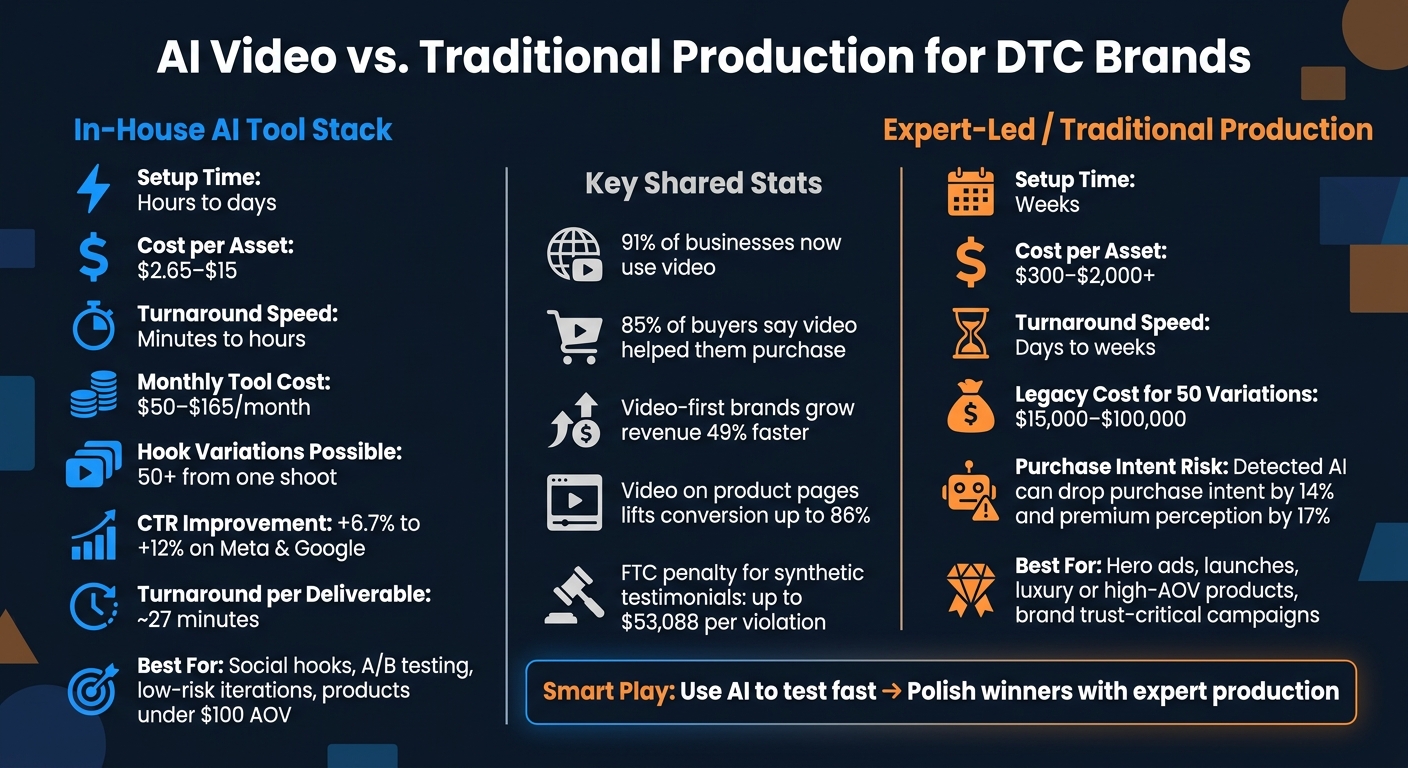
AI Video vs. Traditional Video Production for DTC Brands: Cost, Speed & Performance
Build a repeatable pipeline instead of one-off videos
Once you know which formats are working, the next step is simple: turn that into a system.
Don’t treat each video like a brand-new project. Build one repeatable workflow that runs from the brief all the way to performance feedback. Then batch the parts that change most often, like hooks, body segments, and CTAs, so you can remix fast without rebuilding the whole thing every time.
That setup matters because a winning hook shouldn’t lead to more manual work. It should lead to new versions, faster.
To keep the pipeline steady, use two core assets:
- A Foundation Doc: one source file with your brand’s hex codes, typography, logo placement, and reference photography
- A Script Spine for each video: state the problem, explain the cost of inaction, present your approach, show proof/demo, and close with one CTA
These two pieces give your team a shared starting point. More importantly, they lock in the angles that already worked in the funnel and format tests, so nobody has to start from zero each week.
When self-serve tools work and when expert production is worth it
Once the workflow is in place, the next call is whether to run it in-house or hand it to specialists.
That choice usually comes down to three things: your AOV, your team’s bandwidth, and the job the asset needs to do in the funnel.
For products under $100 AOV, self-serve AI tools make a lot of sense. AI-generated ads improve click-through rates by 6.7% to 12% across Meta and Google. And the monthly tool stack is fairly low: generative video, avatar platform, voice, and editing tools usually cost $50 to $165/month.
The production math gets even more interesting. Full AI workflows can produce finished assets for $2.65 to $15 each, while standard UGC often lands between $300 and $2,000. If you’re testing lots of social ideas, that gap is hard to ignore.
For higher-AOV products, though, things change. Detected AI imagery can cut purchase intent by 14% and premium perception by 17%. That’s a problem if you’re selling trust, detail, or polish, not just clicks.
So for launch campaigns, hero ads, or cases where brand trust carries more weight, expert-led production is often the smarter move. In categories where product detail matters, a hybrid composite workflow can help. In that setup, AI builds the environment, and the real product gets composited in. That helps keep the product 100% accurate and avoids AI errors with logos or textures.
A common middle ground is to use AI for first-pass versions, then bring in expert production for the top ideas. In plain English: AI helps you test fast, and specialists help you polish what wins.
In-house tool stack versus expert-led production: a side-by-side comparison
| Feature | In-House AI Tool Stack | Expert-Led Production |
|---|---|---|
| Setup Time | Fast - hours to days | Slower - weeks |
| Cost per Asset | Lower - about $2.65 to $15 | Higher - about $300 to $2,000+ |
| Turnaround Speed | Minutes to hours | Days to weeks |
| Creative Control | High - iterative | Highest - tightly controlled |
| Internal Workload | High - founder or team operates the tools | Low - specialist-led |
| Best-Fit Use Case | Social hooks, A/B testing, and low-risk iterations | Hero ads, launches, and luxury or high-AOV products |
First steps for founders
Start with one offer, one audience, and a small test batch
Turn this into a simple test plan. Start with one proven SKU, ideally with an AOV under $100, choose one customer segment, and make 5–10 hook variations built around a single problem that product solves. Don’t try to push your whole catalog in week one.
The goal is simple: use one sprint to find your first repeatable winner.
- Week one: pull objections from reviews or support tickets and use them to shape your message.
- Week two: write three different concepts - a direct product demo, a founder explanation, and a testimonial-style proof angle.
- Week three: build your hooks, body segments, and CTAs as separate parts.
- Week four: launch on one paid channel and track hook rate and add-to-cart rate.
This sprint helps you find the hook that gets the click and the offer that gets the sale.
When you test, keep the order tight: hook first, then angle, then format, then CTA.
Review performance weekly and expand what works
Once you launch, use weekly readouts to decide what to scale. Check creative at the single-video level, not campaign averages. Averages can blur the picture. One video might be doing the heavy lifting while another quietly burns spend.
Each week, focus on three numbers: hook rate with a target of 25–30%, hold rate at the 50% mark for clips under 60 seconds, and CPA trend. If CPA climbs 20% over 3–5 days while spend stays flat, that creative is fatigued. Pause it and swap in a new variation. When something works, scale it by 20–30% at a time instead of going all in at once.
Use your winning hooks to seed the next test batch.
Need video like this for your brand?
UGC, commercials, explainers and cinematic — directed with AI, finished like a studio.
Start a project →