Best Performing Video Ad Formats for DTC Brands in 2026
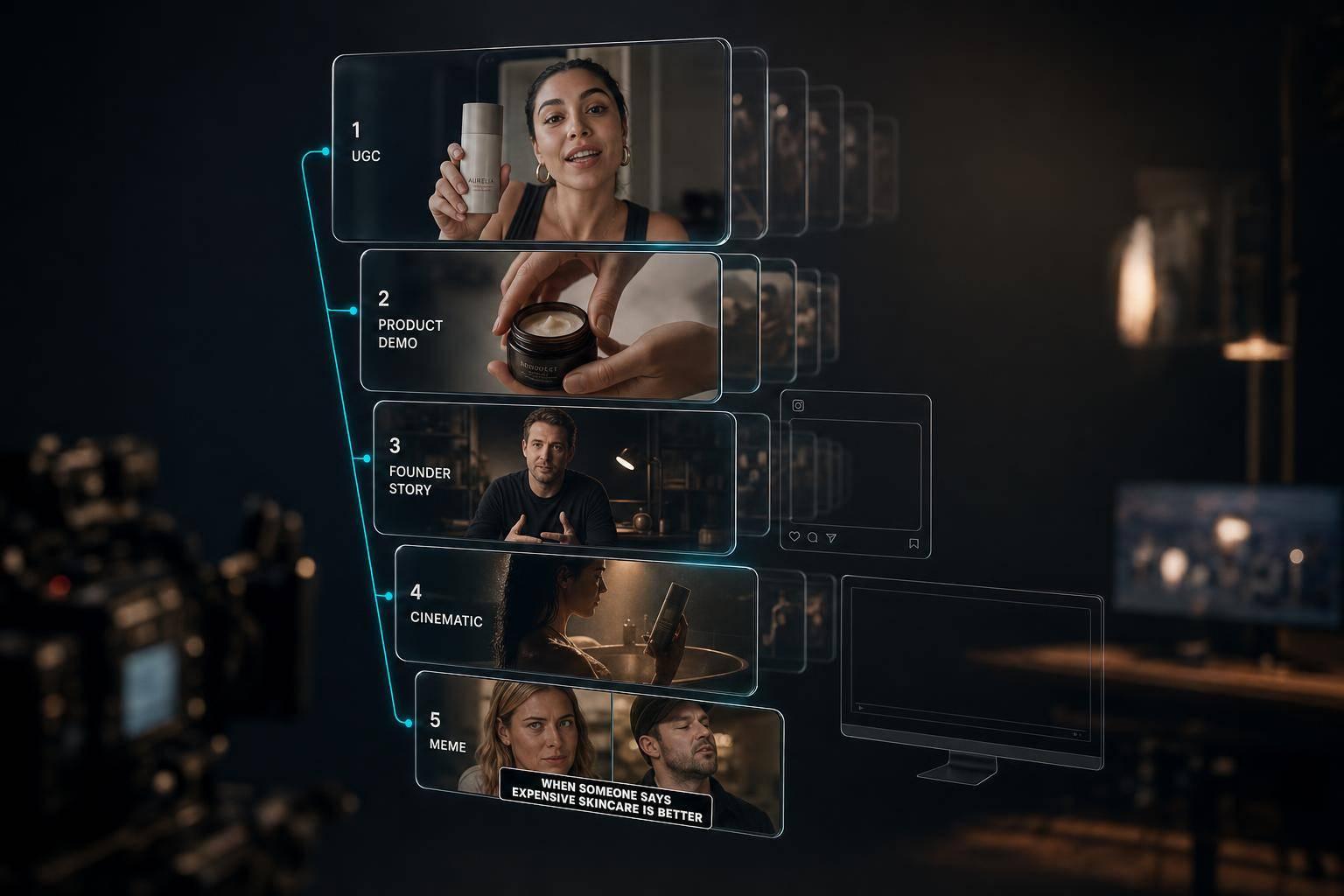
If I had to sum it up in one line: UGC wins for speed, demos win for clarity, founder videos win for trust, cinematic ads win for premium feel, and meme-style ads win for reach.
If you run paid social for a DTC brand, this is the main takeaway: there is no single best video format for every goal. The right pick depends on what you need most - more clicks, better conversion quality, more trust, lower-funnel support, or more top-of-funnel volume.
Here’s the short version:
- UGC/testimonial is often the first format I’d test for clicks and fast learnings.
- Product demos work best when people need proof before they buy.
- Founder videos help when trust is the main blocker, especially in higher-consideration categories.
- Cinematic/brand ads fit premium products and retargeting more than cold traffic.
- Meme/native-style ads are strong for attention and low-cost reach, but they wear out fast.
A few numbers stand out right away:
- Hook rate under 25%–30% usually means the opening is too weak.
- Brands testing 20+ new ads per month report 65% higher ROAS than brands testing fewer than 10.
- UGC-style ads can drive 4x higher CTR and about 50% lower CPC than standard brand ads.
- Product demos can hit 4.5%–7.2% conversion rates and 7x–12x ROAS in retargeting.
- Founder-led ads showed 41% higher CTR, 43% higher conversion rate, and 34% lower CAC in the data cited.
- Meme/native ads often fatigue in just 5–10 days on TikTok.
What this means for you: don’t ask, “Which format is best?” Ask, “Which format fits my funnel stage, platform, and refresh window?”
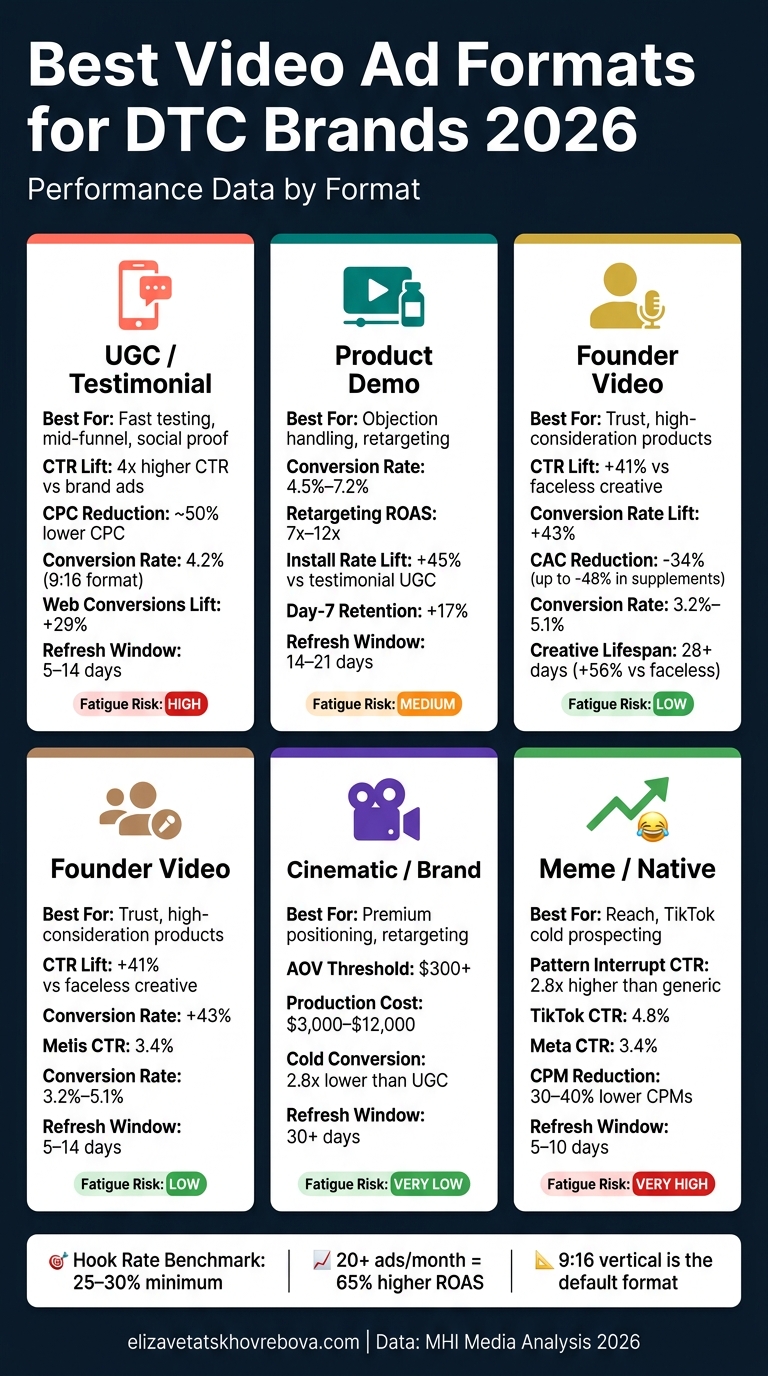
Best Video Ad Formats for DTC Brands: Performance Comparison 2026
I Made 2,627 DTC E-commerce Ads And Learned This
sbb-itb-f51e864
Quick Comparison
| Format | Best for | Main strength | Main downside | Usual refresh window |
|---|---|---|---|---|
| UGC / Testimonial | Fast testing, mid-funnel, social proof | Strong hook rate and CTR | Burns out fast | 5–14 days |
| Product Demo | Proof, objection handling, retargeting | Better conversion quality | Can feel too sales-focused | 14–21 days |
| Founder Video | Trust, high-consideration products | Lower CAC, stronger belief | Hard to scale around one person | 28+ days |
| Cinematic / Brand | Premium positioning, warm audiences | Better perceived value | High cost, weaker cold conversion | 30+ days |
| Meme / Native | Reach, attention, TikTok testing | High engagement, lower CPMs | Trend risk, very short shelf life | 5–10 days |
One more thing matters across all five: vertical 9:16 is still the default, and the first 3 seconds do most of the work. So before you spend more on production, I’d focus on testing more hooks, more cutdowns, and more angle variations from the same base asset.
That’s the lens I’d use to read the rest of this guide.
1. UGC and Testimonial Video Ads
UGC usually wins on hook rate, CTR, and production speed. That’s why it’s often the first format DTC brands test when they need fast creative learnings. These ads work because they don’t look over-produced. They feel simple, direct, and native to the platform. And that matters. People scroll past anything that feels too much like an ad, almost right away, so UGC has to feel like organic content from the very first frame. If the opening line doesn’t stop the scroll, the rest of the ad doesn’t get a chance.
Customer-made content also carries borrowed trust. It feels more like a real opinion than a polished sales pitch. You can see that in the data: UGC-style ads drive about 4x higher CTR and lower cost-per-click by around 50% compared with standard brand creative. On top of that, brands using UGC report an average of 29% higher web conversions.
Hook Rate
The first 3 seconds make the call: watch or swipe.
Strong UGC usually opens with one sharp objection or one clear pattern interrupt. Pattern interrupt hooks alone can drive a 2.8x CTR lift over generic product intros. The best ads don’t lead with a broad brand claim. They hit one specific customer doubt right away. Once that hook lands, the ad needs to back it up with proof.
Conversion Quality
UGC gets conversions by handling objections, not just by being likable.
A solid example is when a creator walks through raw ingredients, sourcing, or production costs on camera. That can turn a price objection into a trust-building moment. Another useful move is running organic content with the original comment section still visible. People tend to trust community feedback more than ad copy.
Format matters too. UGC shot in 9:16 beats horizontal studio video on conversion, with an average 4.2% conversion rate versus 1.7% for horizontal studio cuts.
Scalability
Keep UGC tight: 20–30 seconds is the sweet spot. A simple structure works well:
- hook
- problem
- solution
- proof
- CTA
It also helps to build UGC from swappable parts - hooks, body sections, and CTAs - so you can turn one shoot into lots of variants for different lengths, placements, and angles. And captions aren’t optional. Most Meta video gets watched on mute.
When the product needs more explanation, it makes sense to shift from social proof into a demo format.
2. Product Demo Video Ads
When UGC builds trust, product demos build clarity. They answer a simple question: does this remove the last objection? That’s why demos are usually the next thing to test when UGC gets attention but still doesn’t give people enough proof. That move - from trust to proof - helps explain why product demos drive 45% higher installs per thousand impressions and 17% better day-7 retention than testimonial-style UGC.
Hook Rate
Start with the result, then show how it works. The demo ads that win in 2026 lead with the outcome in the first frame - a before-and-after for skincare, or the mechanism in action for hardware - then work backward to explain what’s happening. That opening does the heavy lifting.
Once the hook shows the outcome, the rest of the ad should focus on one job: answer objections.
Conversion Quality
Demos deal with objections before the click, so the traffic landing on the page tends to be warmer. That’s a big reason demo ads reach conversion rates of 4.5–7.2%, versus 3.2–5.1% for founder ads. In retargeting, the gap gets even bigger: product demos can hit 7–12x ROAS, which makes them the strongest use case for retargeting.
What you show depends on the product:
- Mechanics for hardware
- Textures for skincare
- Before-and-after for beauty and home cleaning
- Screen flows for software
That’s why demos make sense when people already know the category and just need proof to buy. Every visual should answer a clear objection, not just look nice on screen.
Scalability
One shoot should give you more than one ad. Aim to get multiple hooks, multiple lengths, and placements from the same session. Shoot or edit in 16:9, 9:16, and 1:1 instead of relying on auto-cropping later. Keep key visuals and text in the center of the frame, and don’t place anything important in the bottom 40% of the screen, where platform UI can block it.
Captions and audio should each work on their own. And keep the message tight: 2–3 differentiating features with text overlays is enough. Add too many features, and the hook gets weaker while the message starts to blur.
If the product needs trust and proof, lead with the founder and then cut to the demo.
3. Founder Video Ads
If a product demo shows that a product works, a founder ad shows why people should believe it. That matters most in categories where buyers pause before they click buy, like supplements, skincare, baby products, and premium goods. It also helps when you need to explain a higher price point.
The performance data is hard to ignore. Brands using founder-led creative saw a 41% higher CTR and a 43% higher conversion rate than brands without a founder on screen. CAC dropped by 34% compared with faceless creative. In supplements and health, that gap gets even bigger, with 48% lower CAC. A real person on camera signals authority and helps people feel more at ease.
Hook
The best opener is usually personal. The founder talks about an early mistake, or the problem they couldn't fix before they built the product. That kind of start feels human. It doesn't need polished delivery, either. In fact, rougher footage often works better here. iPhone video in natural light outperformed studio production by 31%.
Conversion Quality
Founder ads convert at 3.2%–5.1%, which is lower than product demos. So don't treat them as your only sales asset. They're better used as a trust layer and an objection handler. Think of them as the ad that helps someone say, "Okay, I get who is behind this."
Scalability
You can scale founder ads without making each one from scratch. Record a batch of hooks, body clips, and CTAs in one session, then remix them into dozens of versions.
That also gives you more room before fatigue hits. The creative lifespan is about 28 days, compared with 18 days for faceless creative. That's a 56% longer runway.
Once that trust is in place, cinematic creative becomes the next move for brand lift and premium positioning.
4. Cinematic and Brand Video Ads
Cinematic ads work best for premium perception and retargeting, not first-touch conversion. That’s what makes this format useful for brand lift, premium positioning, and bringing back people who already know you.
Brand Lift and Premium Perception
Polished production can push up perceived value and trust, especially for high-AOV brands. If your product has an AOV over $300, polished creative is often a prerequisite. That’s the tradeoff: you get stronger perceived value, but weaker cold-traffic efficiency. This format tends to do its best work when the path after the click already feels familiar.
Conversion Support Through Retargeting
Use cinematic creative in retargeting, where polished visuals can help close warm traffic. Don’t lean on it as your main cold-acquisition format. The economics get a lot better when one polished shoot turns into many ad variations instead of a single asset.
Reusable Cutdowns
The best way to make the production cost work - usually $3,000 to $12,000 per video - is to film hooks, body sections, and CTAs as separate parts. Then you can cut them into 6-second, 15-second, and 30-second versions for different placements.
Shoot once, then build for:
- Meta Feed
- Reels
- Stories
- YouTube
To do that well, compose for 9:16, 4:5, and 16:9 from the start.
Studio-produced video tends to last 21–28 days before fatigue sets in. That’s longer than most formats, but it still needs a refresh. One shoot, many cutdowns, multiple placements - that’s the model that helps the math make sense.
If cinematic is the premium layer, meme and native-style ads are the speed layer. When speed, humor, or trend fit matter more than polish, the next format is usually the better test.
5. Meme and Native-Style Video Ads
When polished ads start blending into the feed, meme and native-style ads often do better because they move fast and feel like posts people already watch. The big idea is simple: they look like content first. That gives the hook a split second to land before someone decides, “Yep, that’s an ad,” and scrolls past.
Pattern Interruption
The best meme ads break expectations right away. That can mean reversed clips, weird camera angles, whispering, or tight close-ups that feel a little off in a good way. It stops the thumb for a moment, and that moment matters.
Pattern interrupt hooks deliver a 2.8x higher CTR than generic product intros.
| Hook Type | Meta CTR | TikTok CTR |
|---|---|---|
| Pattern Interrupt | 3.4% | 4.8% |
| Problem Agitation | 3.1% | 3.6% |
| Founder/Authority | 2.8% | 3.2% |
| Direct Value Prop | 2.3% | 1.9% |
| Generic Product | 1.2% | 0.9% |
(Source: MHI Media Analysis, 2026)
Platform-Native Behavior
TikTok tends to reward trending audio, fast cuts, and formats like POV or Storytime. That style feels normal there, so the ad has a better shot at fitting in instead of sticking out for the wrong reason.
Meta plays a bit differently. Captions and on-screen text matter more because most people watch with the sound off.
Trend Sensitivity and Creative Fatigue
This format burns out fast. What feels current today can feel old next week. On TikTok, fatigue usually hits in 5–10 days. On Meta, it’s often 7–14 days. Once a trend cools off, the ad starts to feel dated, and people skip it without much thought.
A smart way to handle that is to test on TikTok first with 10–15 native-style concepts per week, then move the winners to Meta . In practice, that makes meme and native-style ads a fast testing ground for hooks before spending more on bigger production.
Pros, Cons, and Platform Tradeoffs by Format
Each format here does a different job in the funnel. The table below shows where each one fits, what it does well, where it falls short, and how soon you'll likely need a new version.
Use it to line up each format with the buyer stage it supports and the pace of replacement it needs.
| Format | Biggest Pros | Biggest Cons | Best Use Case | When to Refresh |
|---|---|---|---|---|
| UGC / Testimonial | High trust/social proof; 4x higher CTR | Fast fatigue; hard to scale authentic versions | Mid-funnel consideration; retargeting | 7–14 days (Meta); 5–10 days (TikTok) |
| Product Demo | 45% higher install rate; clears purchase objections | Can feel salesy without native-style framing | Visual products; top-of-funnel clarity | 14–21 days |
| Founder Video | 34% lower CAC; builds long-term authority | Hard to scale; depends on founder availability | Trust-building; high-consideration categories | 28+ days |
| Cinematic / Brand | Anchors visual identity; sets visual language | High production cost; 2.8x lower conversion than UGC | Retargeting; luxury or premium products | 30+ days |
| Meme / Native | High engagement; 30–40% lower CPMs | Hard to bridge to direct purchase intent | TikTok cold prospecting; awareness plays | 5–10 days |
Fast-refresh formats help you keep volume up. Premium formats help protect brand perception.
One Asset, Many Placements
The main tradeoff isn't just raw performance. It's how fast you can spin each format into new versions before fatigue sets in.
One shoot can feed every platform. Start with one 9:16 master asset, then build versions by changing the hook, caption, pacing, and sound. Brands testing 20+ new ads per month see a 65% higher ROAS than brands testing fewer than 10. That's the kind of output you get when assets are made to be repurposed instead of built as one-offs.
Never repost with a watermark.
Next comes the production system that turns one shoot into many ads.
How to Produce Every Format Fast With AI
The table in the previous section shows you what to make. This section shows you how to make it fast enough to count.
Most production timelines just don't line up with how often these formats need to be refreshed. A standard UGC creator shoot can cost $150–$400 per video and take 5–14 days to come back. But TikTok creative can start wearing out in 5–10 days, and Meta often needs new creative within 10–14 days. That timing falls apart fast when you're trying to scale. So the system can't be built around one-off delivery. It has to be built for speed.
AI helps close that gap. This AI workflow has delivered 500+ videos across 36+ brands in 72 hours on average. Treat direct AI output like a shoot: pay attention to lighting, framing, pacing, and sound. Then export each core asset in 9:16, 4:5, and 16:9.
The fastest setup is modular. Shoot hooks, body segments, and CTAs as separate pieces, then use AI to mix them into dozens of combinations. Start with hooks first. They decide whether anyone keeps watching. Use AI to make the first 20 variations, then save human shoots for the top 5 winners.
The workflow stays the same. What changes is the input for each format.
| Format | Standard Production | AI-Enhanced Production | Best Output Speed |
|---|---|---|---|
| UGC & Testimonial | Manual sourcing, $150–$400 per video, slower to scale | AI-assisted presenters and voiceover variants; automated script variations | 48–72 hours |
| Product Demo | Physical sets, $2,000–$5,000 studio costs, manual editing | AI pulls selling points from a product URL; automated captions and transitions | 24–48 hours |
| Founder Ads | Requires founder availability; limited scalability | AI-assisted scripting and editing of raw footage | 72 hours |
| Cinematic / Brand | $2,000–$10,000+; 2–6 week timeline | AI-generated b-roll; 80% cost reduction | 3–5 days |
| Meme / Native | Manual trend monitoring; fast fatigue in 5–10 days | Instant generation from trending templates; automated batch editing | Under 24 hours |
On the cost side, the difference is hard to ignore. AI production can bring per-video costs down from $2,000–$5,000 for studio work to around $50–$200. Pick the formats your funnel needs, line them up with each platform's refresh window, and build a production system that can keep pace.
Want every format tested without a production bottleneck? Let's build your creative library.
FAQs
Which video ad format should I test first?
Start with a UGC-style talking head and a product demo. These two formats tend to work best on Meta and TikTok because they feel natural and let the product do the heavy lifting.
Keep the talking head under 30 seconds and use a simple problem-agitation-solution flow. For demos, put the result in the first frame, then show how it happened. After that, test before/after, reaction, and listicle formats.
How do I match ad formats to TikTok vs. Meta?
Treat Meta and TikTok like two different creative spaces. They may both run ads, but they don’t reward the same kind of content.
Meta usually does better with polished, conversion-focused creative. Think clear messaging, clean visuals, and a direct path to action. TikTok leans the other way. Raw, native-looking, entertainment-first video tends to feel more at home there.
For Meta, use 1:1 or 4:5 for feeds and 9:16 for Reels. For TikTok, stick with 9:16, keep the pacing fast, use native text, and lead with a quick hook.
You can repurpose the same assets across both platforms. Just don’t post the exact same version everywhere. Edit each one so it fits the platform it’s made for.
How many new video ads should I launch each month?
Plan for a high-volume creative system. Winning ads often burn out within 10 to 21 days, so many brands need weekly testing to keep results steady.
At $10,000 to $50,000 per month in ad spend, most teams test 4 to 6 new creatives each week. On TikTok, where fatigue can hit even faster, many brands need 20 to 40 new concepts per month.
Need video like this for your brand?
UGC, commercials, explainers and cinematic — directed with AI, finished like a studio.
Start a project →