Is AI Video Worth It for Small Ecommerce Brands?
Yes - for most small ecommerce brands, AI video is worth testing if your goal is to make more ads, test them fast, and spend less to find a winner. The tradeoff is simple: you get lower costs and more ad versions, but you still need a person to check product details, claims, and on-screen trust moments.
Here’s the short answer:
- Best use: paid social hook tests, SKU launches, seasonal promos, and short product demos
- Weak fit: founder story ads, customer testimonials, texture-heavy products, and claims-heavy categories
- Main upside: make many ad versions in minutes instead of weeks or months
- Main risk: AI can distort labels, colors, logos, hands, lip sync, and product details
- ROI view: don’t judge it by cost per video alone - judge it by cost to find one winning ad
- Low-risk start: test 3 to 5 versions, spend $20 to $50 per version over 48 to 72 hours, then watch CTR, add-to-cart rate, and cost per purchase
A few numbers stand out. In the source examples, some brands cut video cost from about $3,000 to $3.90 per asset and trimmed production time to under 10 minutes. The article also notes that testing 10+ ad variations can lead to 3–5x higher ROAS than testing fewer than three. That is why AI video makes sense for small teams: it lets you test more without a big production bill.
My takeaway: if you sell online and run Meta, TikTok, or YouTube Shorts ads, AI video is usually a good testing tool - not a full replacement for real people, product shoots, or final brand assets.
| Area | Best answer |
|---|---|
| Is it worth it? | Yes, for testing ads |
| Where it helps most | High-volume short-form ad variation |
| Where it struggles | Trust-heavy and detail-heavy videos |
| What to measure | CTR, add-to-cart, cost per purchase, ROAS |
| Best first step | Run a small paid test before going all in |
If I were a small brand owner, I’d use AI video to test angles fast, keep what wins, and only spend bigger money on the concepts that prove they can sell.
The Honest Case for AI Video
Why faster creative testing can matter more than cheaper production
The biggest edge with AI video isn't just lower cost. It's speed.
More speed means more tests, faster feedback, and less money burned on ads that don't work.
On paid social, ad fatigue often kicks in within 10 to 14 days once spend ramps up. That's a short window. If your team needs weeks to make new ads, you're already behind. AI video gives brands a way to swap in new hooks and offers fast instead of waiting around for the next shoot.
That changes how a team can work. A small crew can make 10 or more hook variations for the same product, then let the ad platform find the one that wins. And that matters because testing 10+ variations per campaign can drive 3–5x better ROAS than running fewer than 3.
Case studies: 1MORE and Whole Life Pet
Two examples from Creatify show this in action.
1MORE cut production time to under 10 minutes per ad and dropped costs to under $3.90 per video. That saved over $10,000 per asset and led to a 47.86% lift in CTR.
Whole Life Pet founder John Gigliotti went from 4 months of production at $3,000 per video to 10 minutes at $3.90 per video. That worked out to about $2,900 saved per asset and a 50x increase in output.
The pattern is pretty clear: AI video does its best work when the goal is fast testing, not polished brand films.
Where AI video fits ecommerce best
AI video works best when a brand needs lots of versions, fast. For small ecommerce teams, the best use cases are:
- Short-form paid social tests: Multiple hook angles for the same product, tested on Meta and TikTok without another shoot
- Seasonal promos: Time-sensitive offers turned around in hours instead of weeks
- SKU launches: First-draft ads for new products pulled straight from a product URL
- Format versions: One idea turned into TikTok, Reels, and Stories at the same time
Paid social tends to work better when new ad creative keeps coming. If a brand can't put enough variations into testing, results can flatten fast. AI video is one of the few practical ways a small team can keep up without a full production budget.
| Traditional Production | AI-Assisted Production | |
|---|---|---|
| Turnaround time | 3–6 months | Under 10 minutes |
| Cost per version | $3,000–$15,000 | As low as $1.20–$3.90 |
| Ad versions per SKU | 1–2 concepts | 10+ variations |
That’s the upside. The next question is where AI video still breaks down.
sbb-itb-f51e864
Where AI Video Falls Short
Live action realism and product accuracy still need human oversight
AI video is fast. But that speed starts to crack when realism, accuracy, or trust are on the line. And that matters most when the ad needs to look exactly like the product and sound exactly like the brand.
One of the most common issues is visual drift. A product may shift shape, color, or label details from one frame to the next. For ecommerce, that’s not a minor glitch. Packaging, labels, and color accuracy can directly affect conversions.
Even Amazon’s own ad team says people still need to step in and catch logo and text mistakes. In one Conair project, AI made most of a 15-second ad, but humans still had to correct logos and brand colors.
"Humans are still needed to guide the creation of the videos, given the state of the technology, which at times alters brand logos, numbers or letters." - Kelsey Smithuysen, Director of Amazon Advertising, Conair
If your product packaging, color, or label text helps sell the product, don’t lean on AI generation by itself. A safer move is to use real product photo overlays or add those details in post-production. In practice, that makes AI a better fit for concept testing than for sales assets where visual accuracy is part of the pitch.
Real testimonials and founder-led content work better when the people are real
Small flaws still give AI avatars away. Think glossy skin, lip-sync drift, or hand movements that just feel off. Viewers may not always know why something feels strange, but they notice it.
That’s a problem when the ad’s main job is trust. If you’re telling a founder story or showing a customer testimonial, real people on camera usually land better. The strongest setup is often a hybrid one: keep the founder or customer on screen for the opening and key message, then use AI for supporting B-roll or extra format versions around that footage.
When AI video is not a good fit
The ROI argument gets weaker pretty fast in a few cases. Regulated products and claims-heavy categories need extra care because AI-generated scripts can slip in implied performance claims that may trigger review if no one catches them first. Tactile products are also tough. When texture, material quality, or craftsmanship is the selling point, AI still struggles with close-up fabric shots, liquids, and other fine surface details.
| Use Case | AI Video Fit | Why |
|---|---|---|
| Social ad hook testing | Strong | High volume, fast iteration, low cost per variant |
| Simple product demos | Strong | Works well for showing basic features quickly |
| Founder / brand story | Weak | AI avatars lack the authenticity viewers expect |
| Customer testimonials | Weak | Uncanny-valley feel can reduce trust |
| Tactile or texture-heavy goods | Weak | AI struggles to render texture or fine detail accurately |
| Regulated product claims | Weak | Higher risk of non-compliant implied claims |
Once you factor in human review and cleanup, the real question is pretty simple: does AI still save enough time and money to be worth it?
The ROI Math for Small Brands
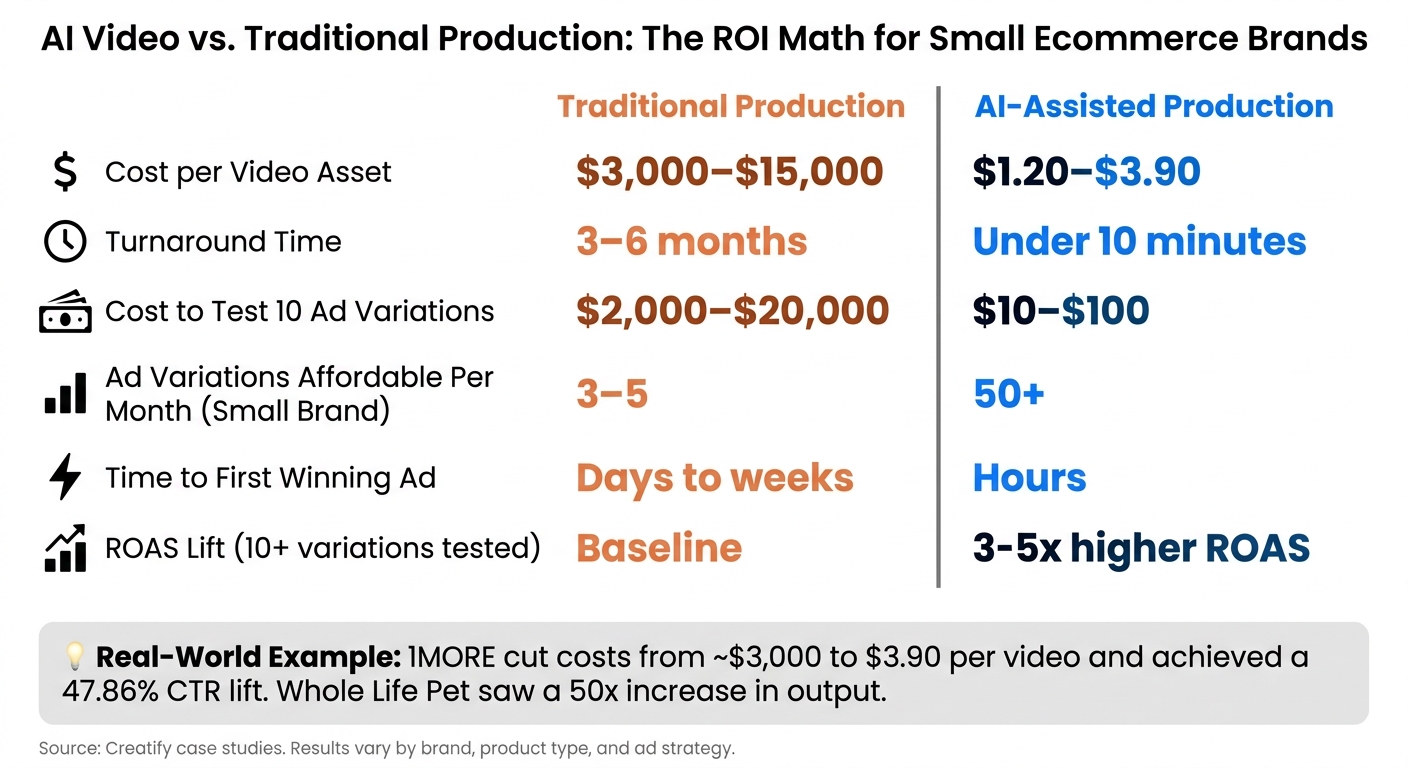
AI Video vs Traditional Production: Cost & Speed for Small Ecommerce Brands
A simple way to estimate AI video ROI
The clearest way to look at AI video ROI isn't cost per video. It's cost to find a winning creative.
If it takes 10 tests to land one winner, then the real expense is the testing process, not just making the ad. That's the part a lot of small brands miss.
Traditional video ads can cost $200–$2,000+ per creative. With AI, testing 50 ad variations costs about $50–$250. For a small brand, that spread changes the whole equation.
A simple place to start is this: plan for 6 to 8 weeks of testing, with 10 to 20 ad variations and $500–$1,500 in monthly ad spend before deciding whether an ad is working. That's enough time and volume to spot patterns instead of reacting too early.
The payoff for testing more is hard to ignore. Brands that test 10+ variations per campaign see 3–5x better ROAS than brands running fewer than three. AI makes that kind of volume cheap enough for smaller teams. But there's a catch: it only helps if the brand can swap out weak ads fast enough before fatigue kicks in.
Why speed-to-market has financial value
Slow production doesn't just waste time. It can cost sales.
Every extra day a weak ad stays live is a day you're paying for poor performance. Creative fatigue usually shows up within 10 to 14 days at scale, and Meta video ads can see about a 30% drop in ROAS in a median of 18 days.
That means delay has a price tag. If a replacement takes too long, you're stuck spending money on an ad that's already losing steam. Faster iteration helps cut weak ads sooner and push winners harder before fatigue hits.
Traditional vs AI-assisted testing: a side-by-side look
For small ecommerce brands, the main comparison is simple: which setup finds a winner faster?
| Metric | Traditional Production | AI-Assisted Production |
|---|---|---|
| Cost to test 10 ad variations | $2,000–$20,000 | $10–$100 |
| Time to first winner | Days to weeks | Hours |
| Ad variations a small brand can afford per month | 3–5 | 50+ |
These are benchmark ranges, not promises. Once the numbers start to make sense, the next step is deciding whether a small brand should test AI video in-house or bring in outside help.
How to Start Cheaply and Decide Whether to DIY or Hire
A low-risk way to test AI video on a small budget
Once you’ve run the ROI math, the next move is simple: test AI video without burning cash. A smart place to start is a URL-to-video workflow. You plug in a product page, and the tool turns it into a draft ad in under 10 minutes.
Then make 3 to 5 hook versions in both 9:16 for Reels/TikTok and 4:5 for Meta Feed. Give each one a small paid test of $20 to $50 over 48 to 72 hours. That’s enough to get signal without going too deep too soon.
Watch the numbers that matter:
- CTR
- Add-to-cart rate
- Cost per purchase
That small test usually tells you a lot, fast.
When DIY makes sense and when hiring a specialist pays off
What you learn from that test helps you spot the real issue. Is the problem speed? Polish? Or a bit of both?
DIY is often a good fit if you’re a solo founder or lean team, have time to learn a new tool, and sell a low-AOV product. It can save money up front. But there’s a catch: AI tools can misrender logos, textures, or labels. So before anything goes live, a person should give each asset a quick review.
Hiring a specialist tends to make more sense when brand consistency and delivery across formats matter more than pumping out a lot of versions. That’s often the case with seasonal pushes, higher-ticket products, or ad programs that need to run across many placements without your team making every asset in-house.
FAQs
How do I know if AI video is a good fit for my products?
AI video makes sense when you need to test a lot of ideas, swap in new ads often, or make assets for a big product catalog. It’s a strong match for top-of-funnel direct-response ads, where speed and low-cost variation can make a big difference.
It’s not the best fit for complex 60-second stories, founder-led trust, or sensitive high-ticket demos where being physically on camera helps drive conversions. In many cases, a hybrid approach works best: use AI to test concepts at scale, then bring in human creators for high-trust assets.
What should I review before publishing an AI-generated ad?
Before you publish an AI-generated ad, put it through a human review for quality and brand compliance.
That step helps catch brand drift, such as altered logos, wrong text, or visuals that stray from brand guidelines.
It’s also smart to check for inaccurate product claims, off-brand messaging, and visual or technical issues. This matters even more with avatars or detailed product visuals, where glitches can slip in and make the ad look off.
Should I make AI video in-house or hire help?
It depends on how much you need to make and how tricky those videos are. AI video works well for small teams that need a lot of ad variations fast without spending a fortune.
That said, you may still want a human touch for brand consistency, hands-on edits, or more complex projects. That’s even more true for videos with real-person testimonials or close-up product shots where texture and detail matter.
Need video like this for your brand?
UGC, commercials, explainers and cinematic — directed with AI, finished like a studio.
Start a project →