AI Video vs Traditional Video Production: Real Cost & Time Comparison (2026)
If you need a 30-second ad in 2026, AI video is usually cheaper and much faster. In many cases, a standard shoot lands around $1,500 to $16,000, while AI ranges from about $1.50 to $22.50 for raw generation and $1,500 to $5,000 for a polished, done-for-you ad.
Here’s the short version:
- Cost: AI often comes in far below a standard production quote.
- Time: Standard production often takes 4 to 12 weeks. AI can move from brief to final cut in 3 to 7 business days.
- Revisions: Standard revisions can cost $500 to $2,000 per round. AI changes are often much cheaper.
- Output: AI makes it easier to ship 5 to 10+ versions from one concept.
- Best use case: AI is a strong fit for paid social, product demos, testing, and localized ads. Standard production still fits hero films, testimonials, and footage that needs live actors on set.
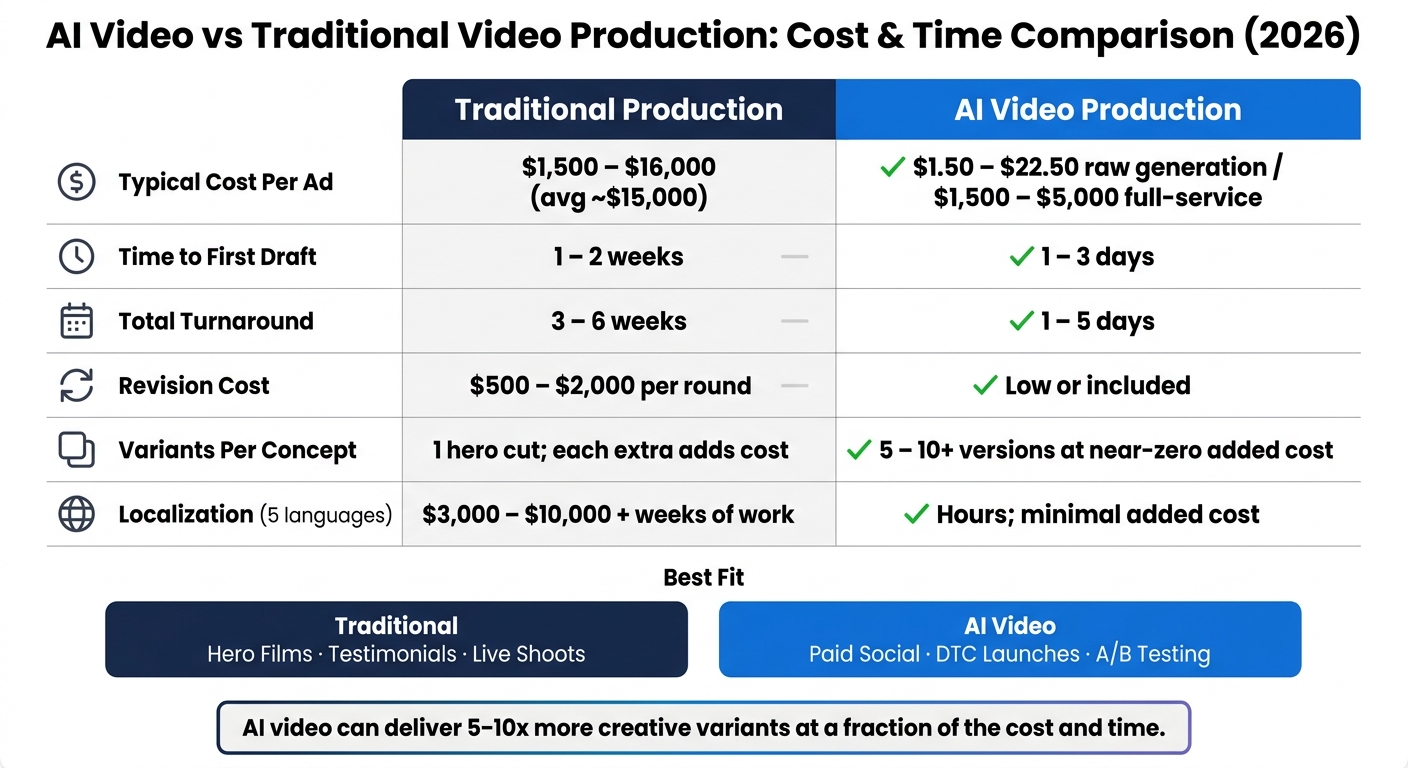
AI Video vs Traditional Video Production: Cost & Time Comparison 2026
Quick Comparison
| Factor | Traditional Production | AI Video Production |
|---|---|---|
| Typical cost per ad | $1,500 to $16,000; many projects around $15,000 | $1.50 to $22.50 raw generation; $1,500 to $5,000 full-service |
| Time to first draft | 1 to 2 weeks | 1 to 3 days |
| Total turnaround | 3 to 6 weeks or more | 1 to 5 days |
| Revision cost | $500 to $2,000 per round | Often low or included |
| Variants | Usually one main cut; each extra version adds cost | 5 to 10+ versions from one concept |
| Localization | $3,000 to $10,000 and weeks of work | Often done in hours at low added cost |
| Best fit | Brand films, testimonials, live shoots | Paid social ads, DTC launches, testing |
What I like about this comparison is that it goes past sticker price. It shows where the money goes, why the timeline changes, and when each option makes sense for your brand.
sbb-itb-f51e864
Traditional video production cost breakdown
Traditional production gets expensive fast because you're paying for people, gear, places, talent, and all the moving parts that have to line up in the same production window. That's why quotes can climb before a single frame even gets edited.
Pre-production, shoot day, and post-production line items
Most budgets split into three phases.
Pre-production usually takes up 15–25% of the total budget. That covers concept development ($500–$2,000), scriptwriting ($1,000–$5,000), storyboarding ($500–$1,500), casting and talent booking ($200–$1,000), and location scouting at $100–$500 per day.
Production - the actual shoot - is often the most expensive phase, usually 40–55% of the budget. A director costs $3,000–$8,000, and a director of photography adds another $2,000–$4,000. Camera and lighting packages rent for $1,000–$6,000 per day. On-screen talent runs $500–$1,500 per day. Location fees come in at $500–$3,000+, while catering and logistics add $200–$500 per day.
And here's where it gets painful: once the shoot is done, changes aren't cheap. Big revisions after filming often mean pickups or full reshoots, which add both time and money. Traditional video gives you control and live-action realism, but you pay for that with crew hours, coordination, and delay.
Post-production usually accounts for 25–35% of the budget. That includes editing at $75–$150 per hour, color correction and grading ($500–$2,000), sound design and mixing ($300–$3,000), music licensing at $100–$500 for royalty-free tracks, motion graphics and titles ($500–$5,000), and revision rounds that usually cost $500–$2,000 each. This is the cost stack AI video aims to cut back.
Why turnaround takes weeks, not days
The timeline stretches because each step depends on the one before it. The script has to be locked before storyboarding starts. Locations and talent need to be booked ahead of time. Post-production can't begin until the shoot is finished. Then every review adds another approval step before the next part can move.
Rush jobs do happen, but they usually come with a 25% to 50% premium on top of the base cost. There's also a cost people don't always see at first: internal time. Project management, review cycles, and stakeholder feedback can eat up hours before anything gets approved.
That's the baseline AI production compresses.
AI production changes this cost stack by replacing most of the physical production and post-production bottlenecks.
AI video production cost breakdown
Raw generation cost vs full production cost
Raw AI generation - the software-only rendering step - can cost about $1.50 to $22.50 for a 30-second video. That sounds cheap, and on paper, it is. But that number only covers the tool output. It doesn't cover the work that turns rough footage into an ad you can actually run.
A polished AI video ad still needs concepting, scripting, direction, editing, color, and sound. Once you add that human work, the total cost for a professional AI-produced commercial usually lands between $1,500 and $5,000 for most brand projects. High-end AI-produced commercials can range from $5,800 to $12,800 - still far below the $25,000 to $70,000 that a similar shoot would often cost.
The big shift is where the money goes. In a standard production, much of the budget is tied up in physical needs like crew, locations, gear, and talent. With AI production, more of that spend moves into scripting, directing, and finishing. Put simply, you're paying less for coordination and more for judgment and craft.
Those cost differences show up most clearly in the side-by-side comparison below.
Why AI can move from brief to first draft in days
AI production lets several parts of the process happen at once. Scripting, visual generation, and rough assembly can run in parallel. There’s no shoot day to book, manage, or push back because of weather, travel, or scheduling issues.
That changes the timeline in a big way. A professional AI project can get to a first draft in 5 to 10 business days, compared with 4 to 12 weeks for standard production.
That speed matters most when you need variants for testing, not just one final cut.
How directed AI video stays premium
AI video is not a one-click process. A directed workflow still includes concepting, scripting, shot direction, editing, finishing, and format-specific delivery. That’s what helps the final piece perform without looking "AI-made."
The human layer is what separates polished work from raw output. Generating footage is the easy part. Picking the right shots, shaping the pacing, and building a clean edit - that’s where the work lives. That’s also why AI video can stay on-brand without feeling generic.
That gap becomes clearer in the side-by-side comparison below.
AI vs traditional video production: side-by-side cost, time, and output comparison
The cost gap matters. But the bigger call is how each model changes speed, revisions, and how many assets you can ship.
Comparison table: cost, timeline, revisions, and variants
| Factor | Traditional Production | AI Video Production |
|---|---|---|
| Typical budget (per ad) | $1,500 – $16,000; ~$15,000 average commercial | $1.50 – $22.50 raw generation; $1,500 – $5,000 full-service AI |
| Time to first draft | 1 – 2 weeks | 1 – 3 days |
| Total turnaround | 3 – 6 weeks | 1 – 5 days |
| Revision cost | High - $500 to $2,000 per round | Low - minutes or hours; often included |
| Variants per concept | 1 hero cut; more versions adds linearly | 5 – 10+ variations at near-zero added cost |
| Localization (5 languages) | $3,000 – $10,000 and weeks | Hours; minimal added cost |
| Best fit | Hero brand films, testimonials | Paid social, DTC launches, ongoing testing |
What comes next is the part media teams care about most: testing cadence, refresh cycles, and output volume.
What the numbers mean for ad buyers
For ad buyers, the table shows one big edge: AI turns one concept into many testable assets.
That matters because performance usually comes from volume and iteration. With old-school production, moving fast gets expensive fast. With AI, it becomes far more doable.
If ad fatigue hits in a few days, a 3- to 6-week production cycle can miss the moment. By the time the next cut is ready, the window may already be closing.
Yes, lower cost grabs attention first. But the bigger win is this: faster iteration and more creative output drive the ROI.
When to use traditional production, when to use AI, and how to choose
Use the comparison above as the starting point. This section shows where each format earns its budget. The choice isn't "AI or traditional." It's about matching the format to the job.
Where traditional production earns the higher budget
Some content still calls for a camera crew. Hero brand films, flagship product launch films, and testimonials are the clearest examples. In those cases, every frame carries brand weight, and viewers expect a level of polish that AI still can't match on a steady basis.
Real human presence is another clear line. CEO addresses, customer testimonials, and founder stories lean on human emotion in a way that matters. Physical products and celebrity or influencer campaigns also need real-world capture and tighter rights control. AI-generated faces are identified by viewers 78% of the time at 1080p resolution. That's a tough risk to accept when trust and recall matter most. If the goal is brand recall, paying more for traditional production can make sense.
Where AI video wins on speed, scale, and ROI
Outside of those higher-stakes moments, AI usually comes out ahead on speed, testing, and output volume.
Performance creative for Meta, TikTok, YouTube Shorts, product demos, and explainer videos is where AI shows the clearest ROI. If one idea needs many versions fast, AI is hard to beat.
Localization is another big advantage. AI can translate and voice a 30-second ad into five languages in hours instead of weeks. Bambee used this model and cut its cost per lead by 50%, with a positive ROI in under one month.
How to get studio-quality AI video without agency overhead
The difference isn't just the output. It's the direction.
The quality gap usually comes from the workflow: scripting, direction, editing, color, and sound. Studio-quality AI video depends on all of that, not just raw generation. That's how AI video can stay studio-grade without agency overhead.
Get a studio-look AI video at a fraction of agency cost - send your brief.
FAQs
What’s included in full-service AI video pricing?
Full-service AI video pricing usually covers end-to-end production management, not just access to a tool.
That means you're often paying for the whole process: creative direction, pre-production workshops, scriptwriting, prompt engineering, and the back-and-forth needed to keep the final video in line with your brand.
It can also include post-production work like editing, color grading, sound design, music licensing, motion graphics, revision rounds, project management, multi-format delivery, and intellectual property clearance for commercial use.
How do I know if my ad should use AI or a live shoot?
Choose traditional production for product demos that need to feel hands-on, live celebrity shoots, or emotional stories where human presence does the heavy lifting. It’s also a strong fit for flagship brand films that need pixel-level control over every frame.
Choose AI production for performance marketing, social content, and high-volume testing. It makes the most sense when you need lots of versions fast, visuals that would cost too much to film, or a polished look on a social media budget.
Can AI video match my brand style and quality?
In 2026, the gap between AI and old-school production is much smaller. Modern AI video can now deliver cinematic color, realistic lighting, and motion that looks convincing on screen. That makes it a strong choice for most performance marketing, social ads, and explainer videos.
Traditional production still has the edge for flagship brand films, human emotion that feels natural, complex storytelling, and product demos that must be filmed for legal reasons.
Need video like this for your brand?
UGC, commercials, explainers and cinematic — directed with AI, finished like a studio.
Start a project →