How Much Does It Cost to Hire Someone for AI Video Ads?
Hiring help for AI video ads in the U.S. can cost from $39 per month to $20,000 per month. The price mostly depends on one thing: are you paying for software, finished videos, or a team that handles the whole process?
If I had to boil it down, here’s the short answer:
- $39–$249/month gets you AI video tools only
- $100–$500/video gets you creator-led, done-for-you video ads
- $8,000–$20,000/month gets you a retainer with a studio or agency
- Rush work can add 25%–50%
- Usage rights across more markets can add 30%–50%
- Only 5%–10% of tested ads may become winners, so cost per winner matters more than cost per video
- A common rule is to put 10%–15% of your monthly ad spend into video production
If you already have people who can write scripts, direct shots, edit, and review outputs, a low-cost tool may work. If you want ads that are ready to run on Meta, TikTok, or YouTube, hiring a creator is often the middle option. If you need many new ads every month plus testing support, a retainer usually fits better.
Quick Comparison
| Hiring model | Typical cost | What you get | Best for | Main tradeoff |
|---|---|---|---|---|
| DIY AI tools | $39–$249/month | Software access | Teams with in-house skills | You do the work |
| Creator-led production | $100–$500/video | Script, AI production, edits, export-ready files | Brands that need done-for-you ads | Less support than a retainer |
| Agency/studio retainer | $8,000–$20,000/month | Planning, production, testing, account support | Brands that need steady output | Higher monthly spend |
The key is simple: don’t ask only what AI video software costs. Ask what it will cost you to get enough ad-ready videos, at the right quality and volume, to test and find winners.
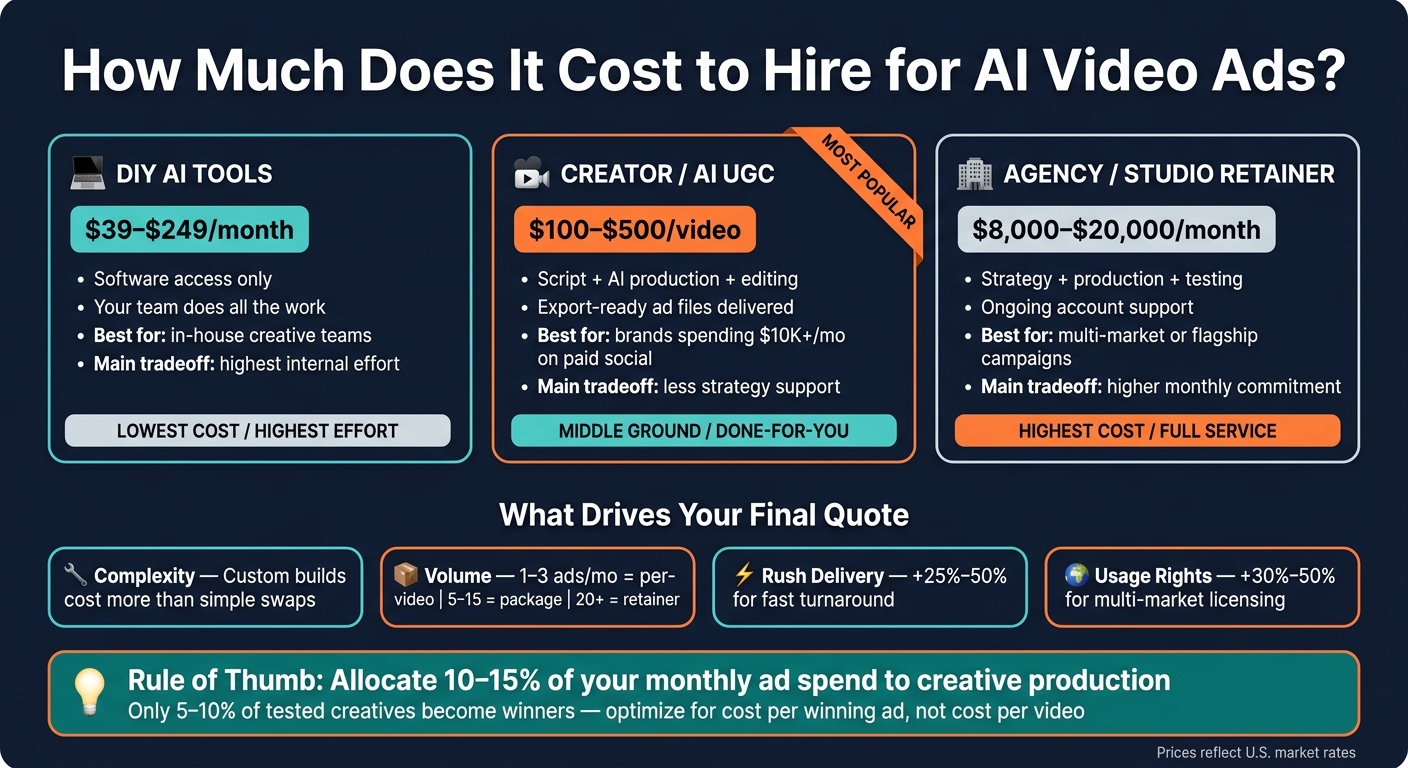
AI Video Ads Cost Comparison: Tools vs Creators vs Agencies
What you are actually paying for in AI video ads
Two AI video ads can look similar on screen and still come with very different price tags. In most cases, the gap comes down to one thing: how much human judgment, craft, and finishing work went into the ad.
Creative strategy, scripts, and ad concepts
Tools can generate footage. People shape the message.
That means deciding on the hook, the offer, and the testing angle. Those choices don't just affect the words on the page. They shape the whole production workflow from the start.
Production and post-production work that changes the final price
Once the concept is locked in, the work moves into production. This part covers directing AI-generated scenes, preparing assets, planning shots, editing, captions, sound, and color correction so the ad is ready to run.
If a project needs multiple versions, the provider also has to deliver the ad in different formats. That extra production work can have a big effect on the final quote.
Why done-for-you AI sits between DIY tools and agency retainers
A DIY tool subscription gives you software. A full agency retainer gives you a bigger team and a more involved service setup.
Elizaveta Tskhovrebova runs a full production pipeline - concept, script, AI generation and shot direction, editing, color grading, sound design, and delivery in multiple aspect ratios - so brands get a finished ad without having to manage each step on their own. That model gives brands finished ads without the overhead of a full retainer. That's why pricing usually falls into three buckets: tool, creator, and agency models.
sbb-itb-f51e864
AI video ads cost by hiring model: tool vs creator vs agency
AI video ad pricing tends to land in three buckets. The big shift from one to the next isn't just price. It's who does the work: your team or the provider.
| DIY Tools | Creators / AI UGC | Agency / Studio Retainer | |
|---|---|---|---|
| Typical cost | $39–$249/month | $100–$500/video | $8,000–$20,000/month |
| What's included | Software only | Ad-ready videos, scripts, and basic edits | Strategy, production, deliverables, and testing |
| Best fit | Brands with strong in-house creative capacity | Brands that need fast, creator-style assets | Brands that need ongoing support and larger monthly output |
| Main tradeoff | Highest internal effort | Less strategy support than a full retainer | Higher monthly commitment |
That’s the main line to watch. Lower cost usually means your team takes on more prompting, review, editing, and back-and-forth. Higher cost means more of that moves off your plate.
DIY AI video tools: $39–$249 per month
This tier pays for software only. Your team still has to handle prompting, direction, editing, and iteration.
That can work well if you already have strong in-house creative capacity and time to manage the process. But if your team is already stretched, the low monthly fee can be a bit misleading. The tool may be cheap. The labor isn't.
If you want someone else to take on the production side, the next move is usually a creator-led service.
Creators and AI UGC production: $100–$500 per video
Here, you're not paying for access to a tool. You're paying for finished assets.
The creator handles the AI generation and editing, then sends over ad-ready files. This is often a good match for brands that need fast, creator-style ads without building the whole process in-house.
It's a simple setup: you buy output, not software. If that output needs to happen every month and at a larger volume, a retainer starts to make more sense.
Agency or studio retainers: $8,000–$20,000 per month
At this level, you're paying for an ongoing relationship with a dedicated creative team.
A monthly retainer in the $8,000–$20,000 range usually covers strategy, production, deliverables, and testing. This setup fits brands that need steady output and don't want to manage each step internally.
Done-for-you AI production sits between DIY pricing and a full retainer. The final quote usually comes down to scope, turnaround speed, and usage rights.
How pricing models and project scope change your final quote
Once you know the market ranges, the next step is figuring out how the pricing setup changes the number you get back.
Per-video vs package vs retainer pricing
Pricing structure shapes the final quote just as much as the base rate.
Per-video pricing works best when you need one high-stakes asset, like a new product launch spot or a hero ad for a single campaign. It’s clean and low-commitment. The tradeoff is simple: the cost per asset is usually higher than it would be in a package.
Package or batch pricing tends to fit better when you're kicking off a new paid social campaign and need 5–10 videos to test. You get a group of assets without locking yourself into a monthly deal.
Monthly retainers start to make sense when your ads are already working and you need a steady flow of new creatives. This setup fits brands running always-on testing and regular creative refreshes.
| Pricing Model | Typical Cost | Best For |
|---|---|---|
| Per-video | $100–$500 | One-off hero ads or product launches |
| Package / Batch | $1,000–$5,000 | Product launches or initial testing |
| Monthly Retainer | $8,000–$20,000+ | Always-on paid social with 10–20+ variants monthly |
After the pricing model, scope becomes the biggest lever in the quote.
The main cost drivers: complexity, volume, speed, and rights
Complexity, volume, speed, and usage rights are the four main reasons two AI video quotes can be thousands of dollars apart.
Complexity is usually the biggest factor. A simple product swap into an existing creative costs far less than a custom build. Fine-detail products, like jewelry, often need more rounds to get right.
Volume changes the math too. As a rule of thumb, 1–3 ads a month usually stay on per-video pricing, 5–15 ads a month often fit package pricing or a hybrid retainer, and 20+ variants a month usually point to a retainer.
Usage rights can add 30% to 50% when ads run across multiple markets. If you already know where the ads will run, say that up front so the quote reflects it.
Turnaround time can add a 25% to 50% premium for rush delivery. Revision rounds matter too. Revisions often mean regenerating scenes, which adds time and cost.
What a provider needs from you to give an accurate quote
If you want a quote that’s close to the final number, send a complete brief from the start. Providers usually need your ad volume, target formats - such as 9:16 for TikTok or 4:5 for Meta feed - target channels, and whether the videos are for organic or paid media use. Three strong reference videos usually help cut down revision cycles.
It also helps to state your budget up front. That gives the provider room to match the scope to what you can spend. Your budget range often shapes how many hooks, personas, and versions make sense.
Those scope choices affect whether the spend gives you enough room for testing and ROI.
How to judge ROI and pick the right budget level
Cost per creative vs speed of testing
Focus on the cost per winning creative, not just the cost per video.
Why? Because only 5–10% of tested creatives turn into profitable winners. So the math that matters is simple: how much does it cost to find the ad that can scale?
Speed matters just as much. High-volume Meta advertisers test 15–25 new creatives per week, and most video ads fatigue within 7–10 days. That creates a pretty tight window. If your team can't ship new concepts before the current batch loses steam, you're already behind.
Here's the gap: old-school production can take weeks, while AI-assisted workflows can turn out variants in minutes to hours. That's a big difference when performance marketing runs on fast feedback.
So the right budget level isn't just about what one asset costs. It's about how many creatives you can test and how fast you can replace tired ads.
Which budget range fits your situation
Start with output. Then line that up with your testing pace.
In most cases, your current ad spend and internal team capacity will tell you which tier fits best.
| Budget Level | Best For | What You Get |
|---|---|---|
| DIY tools ($39–$249/mo) | Brands with internal creative talent and a limited budget | Access to the software; your team handles strategy, scripting, and quality control |
| Creators / AI UGC ($100–$500/video) | Brands spending $10,000+ per month on paid social | Finished, ad-ready assets without having to run the production process yourself |
| Agency retainers ($8,000–$20,000/mo) | Multi-market or flagship brand campaigns | Premium output, multi-model pipelines, and licensing |
A useful rule of thumb: set aside 10–15% of your monthly ad budget for creative production.
So if you're spending $10,000 per month on Meta, a creative budget of about $1,000–$1,500 is often where done-for-you packages start to make more sense than DIY.
The bottom line on AI video ad hiring costs
The main choice isn't whether to use AI. It's which hiring model gives you enough speed and volume to find winners fast.
Done-for-you AI production sits in a strong middle ground. You get the output and pace of AI generation, plus creative direction, without having to manage the tools yourself or lock into a big agency retainer.
For brands that need usable ad volume and fast iteration, that's often the sweet spot.
Once you know your range, the next move is simple: give the provider a brief that leads to an accurate quote.
FAQs
How many ads should I budget to test before expecting a winner?
Plan your budget so you can test at least 3 to 5 ad variations for each product before you expect a clear winner. In paid social, the best hook is often not the one your team thought would win.
So instead of judging the budget around one video, think in terms of the full testing round. AI can help you make more variations for less money, which gives you room to spot winning angles before you put more into higher-end production.
When does a monthly retainer make more sense than per-video pricing?
A monthly retainer makes more sense when you need steady, high-volume performance marketing instead of one-off video production. It fits best when you want a partner to handle the full creative cycle, from research and scripting to feedback and platform-specific formatting.
It also helps when you’re spending more than $3,000/month on content or management but still can’t maintain a steady posting cadence. Put simply, you’re paying for an ongoing system built to improve and scale ads, not just a batch of individual videos.
What should I include in my brief to get an accurate quote?
Include the basics upfront: product assets like clear reference images, brand guidelines, and logos; the target output, including the number of ads, video length, and aspect ratios; the scope of services; the testing plan; and the use case.
That gives you a quote that matches the full job, not just the top-line rate. It also helps account for script refinement, persona setup, and human-in-the-loop quality checks.
Need video like this for your brand?
UGC, commercials, explainers and cinematic — directed with AI, finished like a studio.
Start a project →