AI Video Ads for Ecommerce: The 2026 Guide to Higher-Converting Creative
Video helps sell products, and AI cuts the time and cost to make more ads. If I run an ecommerce brand in 2026, the big win is simple: I can test more hooks, more formats, and more offers without waiting weeks or spending $1,500 to $16,000 on each ad.
Here’s the short version:
- Video drives buying: 85% of people say video has convinced them to buy.
- Cold traffic needs short ads: about 6 to 15 seconds with the hook in the first few seconds.
- Retargeting needs more proof: often 30 to 60 seconds with reviews, demos, and objection handling.
- Feed-style ads often do better: rougher, native-looking videos can beat polished brand ads.
- Testing more variants helps: brands running 5+ versions often see 23% lower CPA.
- AI cuts production time: from 2 to 6 weeks down to hours or days.
- AI cuts cost: from agency-level budgets to as low as $2.65 to $15 per video in some workflows.
- Quality still matters: if the ad looks fake, trust drops fast, especially for products over $100 AOV.
If I had to boil the full article down to a few points, it would be this:
- AI video ads are a production shortcut, not a full replacement for human direction.
- The best-performing formats still depend on funnel stage: UGC, demos, founder videos, reviews, and trend-led spots each do a different job.
- The main edge is testing volume: more ad versions, less delay, lower spend per test.
- The main risk is bad output: strange faces, warped motion, or weak product detail can hurt results.
- Brands need to pick a path: use DIY tools for low-cost testing, or use a done-for-you service for launch-ready ads.
A fast side-by-side helps make that clear:
| Topic | Main takeaway |
|---|---|
| Why AI video ads matter | More ads, lower cost, less waiting |
| Best use case | Testing hooks, offers, and SKU-level variants |
| Best cold ad length | 6–15 seconds |
| Best retargeting ad length | 30–60 seconds |
| Formats that work | UGC, demos, reviews, founder videos, meme/trend ads |
| Main production risk | Ads that look synthetic or off |
| DIY fit | Early testing and high output |
| Done-for-you fit | Brands that want launch-ready ads fast |
Bottom line: if I want higher-converting ecommerce video ads, AI is most useful when I use it to make more tests, not just cheaper ads. The brands that win are the ones that pair AI speed with clear direction, strong hooks, and a final human check before launch.
What AI video ads for ecommerce actually are
An AI video ad for ecommerce is performance ad creative made with AI helping across scripting, visuals, voiceover, editing, captions, and exports. A human still directs the angle, the offer, and the brand voice. So the main question isn’t whether AI makes the ad. It’s which parts of the workflow AI should handle.
Used well, AI cuts the production bottleneck. That means teams can test more hooks, more offers, and more edits without getting stuck in the usual back-and-forth.
Where AI fits in the production workflow
A human strategist starts by choosing the angles to test. That could be a problem-agitate-solve hook for cold prospecting or a social proof angle for retargeting. After that, AI takes care of much of the execution: it can draft scripts from a product URL, generate voiceover, animate product photos, add captions, and export 9:16, 1:1, and 16:9 versions.
People still need to do the last pass. Does the product look right? Does the hook hit? Are there obvious AI artifacts, like bad lip sync, odd product motion, or synthetic faces?
Once that process is set, placement shapes the length, angle, and editing style.
Where these ads run in the funnel
For cold prospecting, shorter videos tend to work best, usually in the 6 to 15 second range. They need to open with a direct product hook or clear benefit in the first 3 seconds. There’s a good reason for that: more than 70% of viewers on TikTok and Instagram Reels decide whether to keep watching within the first 1.5 seconds.
For retargeting, longer videos usually do better, often around 30 to 60 seconds. These ads can answer objections, add customer reviews, and build urgency. AI can also make Dynamic Product Ad (DPA) videos by pulling images and prices straight from a Shopify product feed.
That workflow matters because feed-native creative is what wins attention and drives conversion.
sbb-itb-f51e864
Why AI video ads convert well for many DTC brands
The main edge here isn't novelty. It's speed to conversion testing.
AI video ads tend to convert well because they fit how people use social feeds, and they make high-volume testing far less expensive. On Meta, video ads drive 48% more purchases than static formats when targeting cold audiences. So yes, video works. AI just makes it much easier to test at the pace ecommerce demands.
Feed-native creative wins attention faster
Polished commercial-style ads often feel out of place in the feed. What tends to stop the scroll is feed-native creative: handheld framing, natural lighting, burned-in captions, and a real person - or a convincing AI avatar - speaking straight to the camera.
That style works because it blends into the platform instead of fighting it. Feed-native AI ads outperform polished brand content by 30–50% on average because they don't read as an ad at first glance.
Captions matter more than many brands think. About 85% of social video is watched without sound, which means hard-coded subtitles help the hook land even when playback is muted. And that ties back to speed: the faster you can test new hooks, the faster you can spot what sticks.
Faster turnaround means more testing per week
AI changes the production math. Instead of waiting 2–4 weeks for a shoot, teams can get new hooks live in days.
That speed gives brands room to test more angles, more openings, and more offers in the same week. And that matters. Brands running 5 or more creative variants per ad set report 23% lower CPAs than brands running only 1–2. More variants lead to more data, faster winner selection, and less spend wasted on ads that have already burned out.
Scaling personalization and social proof without reshooting
AI also makes SKU-level variants and review-led retargeting much easier to produce without booking another shoot.
That tends to show up most in:
- UGC
- Product demos
- Founder-led ads
- Trend-native concepts
In plain terms, teams can tailor more ads to more products and audiences without slowing down production.
Ecommerce video ad formats that convert in 2026
The ad formats that convert best in 2026 are the ones that fit the funnel. You want the format to match buyer intent and the moment where someone hesitates. Put simply: the best AI video ad format is the one that removes friction at the exact point a shopper is about to stall.
UGC, reviews, and product demos
UGC-style ads still work as one of the best entry points for cold traffic. Handheld footage, imperfect framing, natural lighting, and someone talking straight to camera feel more native to the feed. That’s why unboxings and creator-style reviews keep working: they stop the scroll without screaming ad.
Product demos play a different role. They help qualify buyers before the click. Get the product on screen in the first second. A tight close-up that shows texture, size, or one key feature can answer buying questions fast. That matters on paid social, and it matters on PDPs too, where product demos can lift conversion rates by up to 34%.
Cold traffic usually needs interruption. Warm traffic usually needs proof and objection handling. For retargeting, longer testimonial-style videos often do better because they can answer doubts directly and stack social proof in a way that feels grounded.
Founder-led, cinematic, and launch creative
Higher-consideration products don’t need more polish. They need more trust.
Founder-led ads help build trust and show what makes the brand different. Buyers tend to trust AI-looking ads less, especially when AOV is above $100. That’s the trust problem AI has to solve for higher-AOV products.
Cinematic hero spots and launch videos fit a much narrower job: brand-building launches. Use them when trust and brand meaning matter just as much as the offer itself.
Meme and trend-native ads
Meme-style and trend-native ads work best on TikTok and Reels, where they can slip past ad blindness. But they have a short shelf life. Refresh them fast, before the format starts to feel old.
The product still has to stay at the center. Trend-shaped creative works when the trend is just the wrapper and the product is the payoff. AI helps here because it makes production faster, which gives you a better shot at hitting a trend window before it closes.
| Format | Best Funnel Stage | Best Fit | Refresh Cadence |
|---|---|---|---|
| UGC / Testimonial | Cold + Retargeting | Under $100 | Fast |
| Product Demo | Cold Prospecting + PDP | Any | Fast |
| Founder-Led | Warm / High-consideration | Over $100 | Seasonal |
| Cinematic / Launch | Brand + Seasonal | Over $100 | Per campaign |
| Meme / Trend-Native | Cold (TikTok / Reels) | Varies | Fast (every 5–10 days) |
Once you’ve picked the format, the edge comes down to cost, speed, and one simple question: does the ad still look human?
AI vs. traditional production: cost, speed, and quality
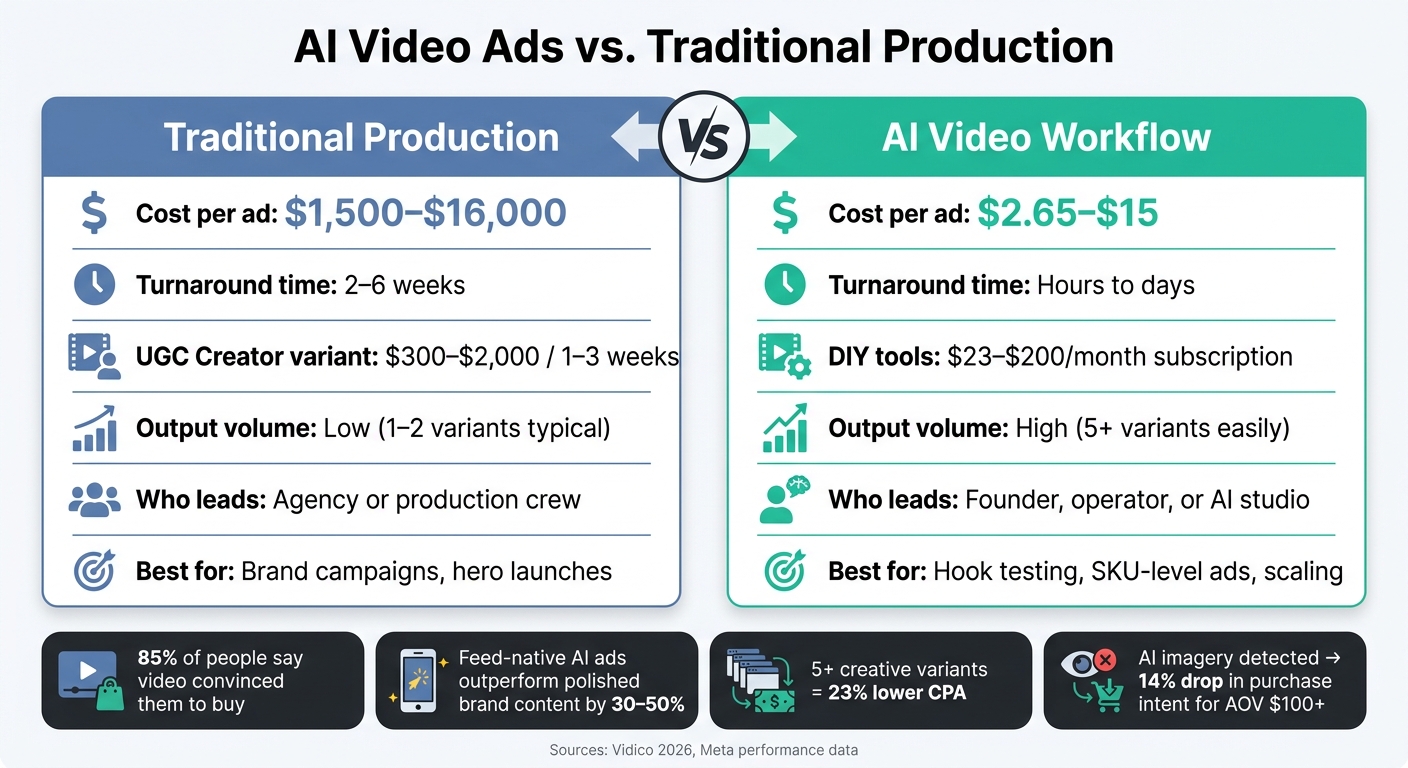
AI Video Ads vs. Traditional Production: Cost, Speed & Performance Stats
Format is only half the call. The other half is production cost - and how fast you can get an ad live. That matters because faster turnaround gives you more hooks, more offers, and more shots at finding a winner.
Cost and turnaround
Traditional ecommerce video production runs $1,500 to $16,000 per video (Vidico, 2026), with a typical agency project taking 2 to 6 weeks from brief to final file. AI video workflows change that math in a big way: finished assets can cost $2.65 to $15 per video, with final assets shipping in hours or days instead of weeks.
That difference adds up fast. Lower cost and shorter turnaround let brands swap out tired ads sooner and test more angles in the same time frame.
| Production Method | Typical Cost per Ad | Turnaround Time |
|---|---|---|
| Traditional Agency | $1,500–$16,000 | 2–6 weeks |
| UGC Creator | $300–$2,000 | 1–3 weeks |
| AI Video Workflow | $2.65–$15 | Hours to days |
There’s one catch, though: raw AI output is not the same as launch-ready creative. A usable ad still needs product accuracy, clean pacing, and a final edit before it’s ready to go live.
Why creative that doesn't read as AI is the real quality benchmark
Low cost only matters if the ad looks believable in-feed. If people spot it as synthetic in the first 2 seconds, the ad is already in trouble. Fake-looking faces, warped product physics, or distorted hands can kill trust before the hook even has a chance to work.
That’s why the bar for quality isn’t “Was this made with AI?” It’s closer to: Can a shopper tell? The best human-directed AI ads avoid the usual tells through careful choices in motion, product fidelity, and pacing, without weird visual artifacts pulling attention away from the message.
One method that works well is the AI-generated scene plus real product photo approach. You use AI to build the setting, then composite a real, unaltered product photo into the scene. It’s a smart middle ground. You keep product accuracy at 100% while still getting the speed gains from AI production.
This trust gap gets sharper with higher-AOV products. For products with an AOV above $100, consumer purchase intent drops 14% when AI imagery is detected. So the takeaway isn’t to avoid AI. It’s to put a quality check into the workflow before anything goes live.
Next comes the build-vs.-buy decision: do you make these ads in-house, or use a done-for-you workflow?
How to get AI video ads made for your store
Once you know AI ads can work, the next call is pretty straightforward: make them in-house or hand them off.
DIY tools vs. done-for-you production
DIY is a good fit for early-stage brands that want to test hooks fast without burning cash. AI tools can turn out clips at a low per-asset cost, and you can make a lot of variations in a short time. That helps when you're trying to spot what clicks before putting serious money behind it.
The catch usually shows up later, when you try to scale. If the creative direction isn't strong, DIY ads can fall short on the thing that matters most: do they feel like native creative, or do they look like ads people scroll past?
DIY is built for fast testing. Done-for-you is better for brands that need polished ads ready to launch.
Done-for-you production covers the whole process, from strategy to final delivery. Our AI video production studio handles concept, scripting, generation, editing, and multi-format export, so each asset is ready for the platform from day one - and built to convert, not just go out the door fast.
Want done-for-you AI video ads for your store? Send a 30-second brief and get options back in days - reach out through the Contact form or directly via Telegram or WhatsApp.
| DIY AI Tools | Done-for-You Studio | |
|---|---|---|
| Cost | $23–$200/month | Project pricing |
| Turnaround | Minutes to hours | Turnaround in days |
| Volume | High variation output | Polished batch of launch-ready ads |
| Who leads | Founder/operator | Director + strategist |
| Best for | Early testing, SKU-level ads | Hero launches, brand scaling |
What to include in a 30-second brief
Whether you go DIY or outsource, a tight brief cuts revisions and keeps production moving. You don't need a big deck. You just need seven things:
- Product URL or high-res images - so the studio can see exactly what's being sold
- Target audience - cold, warm, or loyalty
- Core offer or primary benefit - the main thing the ad needs to say
- Proof points - reviews, ratings, or one clear result
- Desired style - UGC, cinematic, or demo
- Target platforms - Meta, TikTok, YouTube, or a mix
- Deadline - so turnaround can be scoped the right way
The more specific you are, the less back-and-forth you'll deal with before production starts.
FAQs
How many AI video ads should I test at once?
Don’t put all your weight on one ad. For a stronger launch, test 3 to 5 creative variants in each campaign. That gives you more data, cuts down on guesswork, and helps you stay ahead of creative fatigue.
Once you start scaling, many DTC brands bump that up to 20 to 30 new variations per week. Why? Because ad fatigue often kicks in after 7 to 10 days. AI helps make that pace easier to keep up with, including turning out five or more variants in a single afternoon.
When should I use AI video ads instead of real UGC?
Use AI video ads when you need a lot of creative, fast testing, or product-first visuals. They work best when you're launching five or more ad sets, swapping in new creative every one to two weeks, and showing off SKUs that don't rely on heavy human-led storytelling. They're also the most cost-effective pick for products with an AOV under $100.
Stick with real UGC for founder-led storytelling, regulated categories, and luxury brands with an AOV above $500, where a real person on screen can help preserve trust and conversion rates.
What makes an AI video ad feel trustworthy?
A good AI video ad needs to feel human while staying clear about the product. Skip AI slop. That’s extra true for static thumbnails with synthetic-looking avatar faces, which can make the whole ad feel fake at a glance. Keep the creative tied to the real world.
When you’re selling higher-priced items with an AOV above $100, trust carries more weight. Use the founder’s cloned voice, real product B-roll, and scripts built from verified customer reviews.
Need video like this for your brand?
UGC, commercials, explainers and cinematic — directed with AI, finished like a studio.
Start a project →