AI UGC vs Real UGC Creators: Which Drives Better Ad Results?
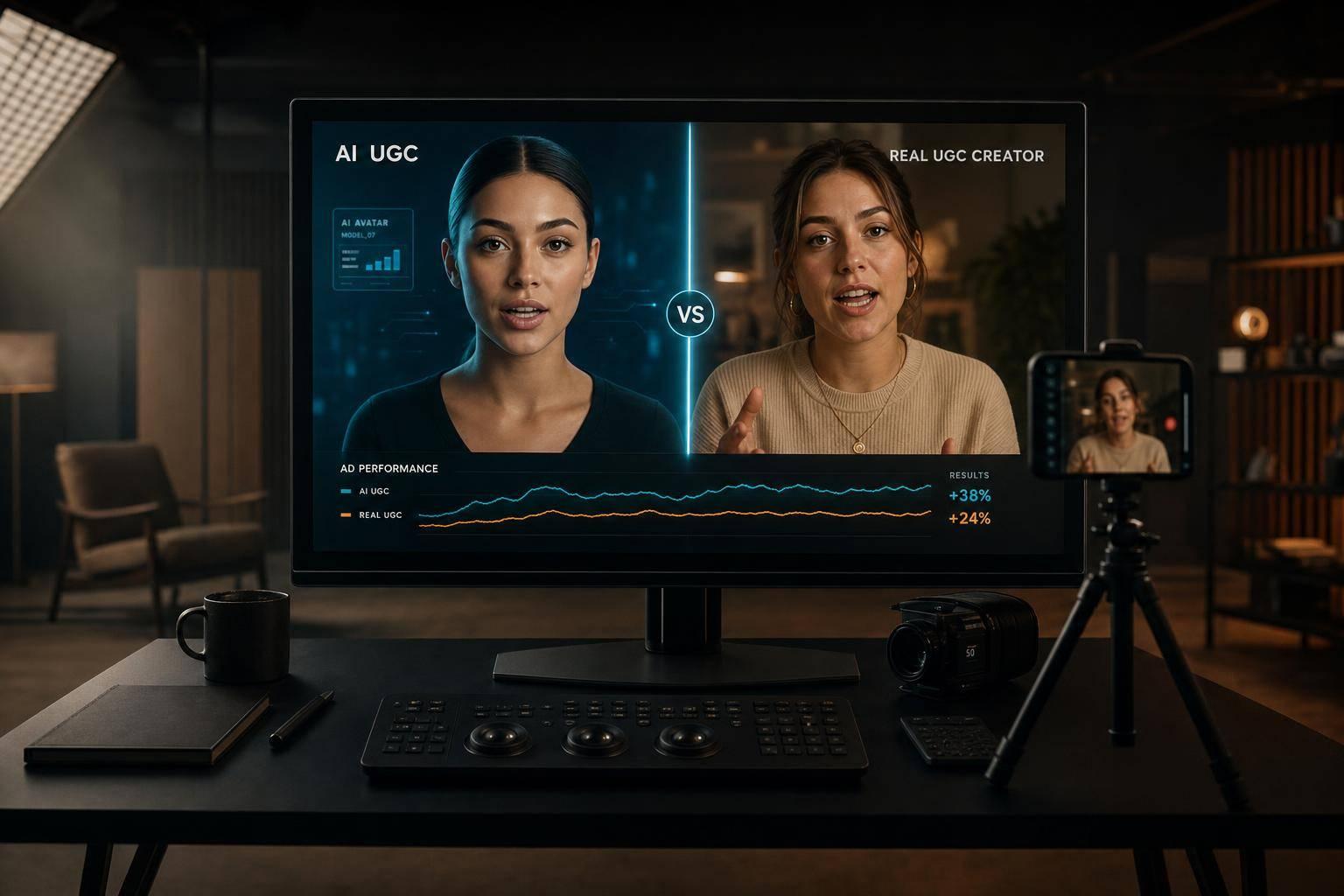
If I had to give one short answer, it’s this: use AI UGC for low-cost testing and volume, use real UGC creators for trust and sales, and use a hybrid setup if you want both.
Here’s the article in plain English:
- AI UGC is cheaper and faster. Brands can make videos in minutes, often for $0.50 to $30 per video, and test 20 to 50+ versions at once.
- Real UGC creators cost more and take longer. Most videos land in 7 to 14 days and often cost $100 to $500+ per video, plus paid usage fees.
- AI often does well at the top of the funnel. It can hold up on CTR and works well for hook testing, angle testing, and ad refreshes.
- Human creator videos often do better when trust matters more. That matters more for skincare, supplements, higher-ticket products, and other purchases where people want to see a person use the item.
- The best setup for many brands is mixed. Test hooks with AI, then give the winning angle to a human creator to turn it into a sales-focused ad.
That means your choice should come down to three things:
- Budget
- Testing speed
- Funnel stage
If you need lots of ad variants by June 2026 standards, AI gives you more shots on goal for less money. If you need stronger buyer confidence, a real person on camera still tends to do better.
Quick take: AI wins on cost and scale. Human UGC wins on trust and lower-funnel conversion. Hybrid is often the best middle ground.
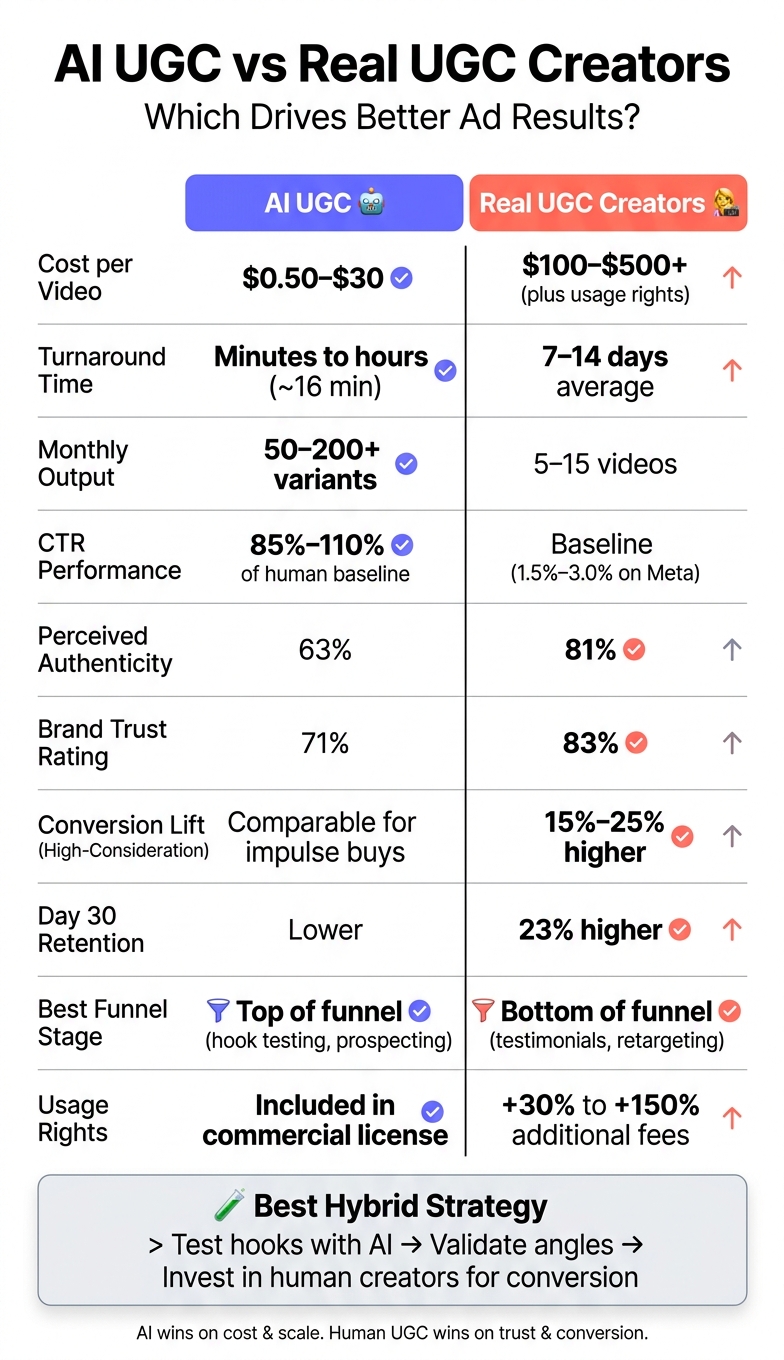
AI UGC vs Real UGC Creators: Cost, Speed & Performance Compared
AI Video vs Authentic UGC: What Actually Works for Beauty Brands | CEW Future Beauty Summit 2026

sbb-itb-f51e864
Quick Comparison
| Criteria | AI UGC | Real UGC Creators |
|---|---|---|
| Best for | Hook testing, prospecting, ad volume | Testimonials, demos, retargeting, sales |
| Cost | $0.50–$30 per video | $100–$500+ per video, often more with rights |
| Turnaround | Minutes to hours | 7–14 days on average |
| Output | Many variants at once | Usually 1–2 edited videos per project |
| Main upside | Low cost, fast testing, lots of versions | Human presence, product handling, buyer confidence |
| Main downside | Can feel flat or fake over time | Higher cost, slower changes, added licensing fees |
| Best funnel stage | Top of funnel | Bottom of funnel |
| Best overall use | Find what message gets clicks | Turn proven messages into sales |
If I were choosing, I’d keep it simple: start with AI to test ideas, then put money behind human-shot ads that prove they can convert.
What AI UGC and real UGC creators actually deliver
Both can look like creator-style in-feed content, but they do very different work. The best way to see the gap is to look at what each one actually makes.
AI UGC ads: avatars, AI voice, scripting, and fast variations
AI UGC is creator-style video made entirely with artificial intelligence. You give the tool a script or a product URL, and it turns that into a finished video with a licensed avatar, AI voice, captions, and product B-roll. In many cases, a finished video can be ready in about 16 minutes.
What you get here is scale. Not one carefully crafted ad, but a batch of versions built from the same idea. Brands often make 20–50 variations of a single concept, swapping hooks, avatars, and CTAs to see what lands. Most finished videos are 9:16 vertical and 15–30 seconds long, so they fit naturally into TikTok, Reels, and Shorts. Cost is usually low too, with production often landing between $5 and $30 per video.
Real UGC works in a very different way. It starts with a person, not a prompt.
Real UGC creators: human demos, testimonials, and social proof
Real UGC starts with a human creator, often a customer, influencer, or founder, filming on a smartphone in their own space. The finished piece might be a testimonial, product demo, unboxing, or lifestyle clip. Its edge comes from the little things you can’t plan perfectly: a laugh, a dog in the background, a slightly messy room. Those details can make the video feel more like something a real person would post.
Timing is slower. From brief to final delivery, brands usually wait 7 to 14 days. Entry-level deals often include one round of revisions and deliver just one or two edited videos per campaign. Pricing is higher as well. Many creators charge $100 to $500 per video before usage rights, and paid-ad licensing can add another 20% to 100%+ on top of the base fee.
Side-by-side comparison: AI UGC vs real UGC creators
| Dimension | AI UGC | Real UGC Creators |
|---|---|---|
| Production method | Script or URL → AI avatar + voice → finished video | Creator briefing → filming → editing → delivery |
| Turnaround time | ~16 minutes | 7–14 days average |
| Common deliverables | 20–50+ variants, multiple hooks, aspect ratios | 1–2 edited videos, raw footage, testimonials |
| Cost per video | $5–$30 | $100–$500+ base; usage rights extra |
| Key strength | Speed, scale, low cost per variant | Trust, lived experience, physical product handling |
| Key limitation | Lower perceived authenticity | Slow to iterate; licensing fees add up |
The biggest difference shows up fast: AI UGC is built for speed and volume, while real UGC is built around human presence, product handling, and social proof.
Cost, speed, and scale: where AI has the edge
What real UGC creators charge, including usage-rights fees
Real UGC gets pricey fast.
Many UGC creators charge $100–$500 per video, based on what you need and how the content will be used. Premium creators can charge $800–$2,000+ per video. Then come the usage-rights fees: paid-ad rights often add 30%–50% to a standard deal, and perpetual rights can push that up to 150%. If you want Spark Ads or whitelisting, that can add another 20%–50% on top.
So one video isn’t just one video. Once you add rights, edits, and extra rounds, the bill climbs in a hurry. And if you want to test new hooks? That usually means starting production again.
Why AI UGC launches faster and costs less per variant
AI UGC runs on a different pricing model.
Most tools charge either a monthly subscription of $39–$399 or a small per-video fee of $0.50–$30. In many cases, commercial usage rights are already included.
The scale changes the math even more. AI UGC can produce 50 variations for about $99. Getting that same volume from real creators would cost about $7,500–$10,600 once usage rights are included. On TikTok, where creative fatigue can hit within 7–10 days, that speed matters a lot.
That’s why AI works so well for testing. It doesn’t automatically mean the AI version should be the final winner, but it gives teams a much cheaper way to find what has a shot.
Side-by-side comparison: cost, turnaround time, and monthly output
| Factor | AI UGC | Real UGC Creators |
|---|---|---|
| Price per video | $0.50–$30 | $100–$500+ base |
| Usage rights | Included in commercial license | +30% to +150% additional fees |
| Turnaround | Minutes to hours; instant re-render | 10–21 days; days for re-brief/re-shoot |
| Typical monthly output | 50–200+ variants | 5–15 videos |
That kind of output is useful when you’re testing hooks at the top of the funnel.
For a brand testing 30 creatives per month, an all-creator setup costs about $9,000 and takes 2–3 weeks to pull off. An AI-first setup can produce that same volume in 48–72 hours for under $600.
So yes, cost and speed lean hard toward AI. The next issue is tougher: does the ad feel real enough to get someone to trust it and buy?
Authenticity and performance: where each format wins
AI avatars vs creators: what feels real enough to hold attention
AI UGC is often strong at stopping the scroll, especially in hook-first, top-of-funnel tests.
But the longer the ad runs, the more cracks tend to show. Robotic gestures, stiff voices, and thin emotion become easier to spot. The most common tells are robotic gestures (67%), unnatural voices (55%), and flat emotional tone (51%). Once viewers notice that, attention can drop fast.
This shows up most in trust-heavy categories like skincare, supplements, or products priced above $100. In those cases, people usually want to see actual use, imperfect lighting, and someone physically handling the product before they buy. That’s the point where attention has to turn into intent.
AI gets clicks; real customer content drives conversions
AI UGC can win the scroll. Real UGC often wins the sale.
On click-through rate, AI UGC ads can hit about 85% to 110% of the CTR of strong human creator content. That’s close enough to matter, and in some tests, close enough to make AI a solid option for early funnel work.
But once the purchase takes more thought, human UGC tends to pull ahead. For higher-consideration buys, human UGC can deliver a 15% to 25% conversion lift. And users gained through real UGC show 23% higher Day 30 retention.
Aubado’s Meta test shows the tradeoff well. Human content beat AI on CTR, with 2.4% vs. 1.9%. AI, though, won on ROAS, at 2.8x vs. 2.3x, because it was cheaper to make.
The split gets even easier to see when you look at funnel performance side by side.
Side-by-side comparison: CTR, conversion rate, trust, and funnel stage
| Metric | AI UGC | Real UGC Creators |
|---|---|---|
| CTR | 85%–110% of human baseline | Baseline (1.5%–3.0% on Meta) |
| Conversion rate | Comparable in transactional or impulse-buy niches | 15%–25% higher for higher-consideration purchases |
| Perceived authenticity | 63% | 81% |
| Brand trust rating | 71% | 83% |
| Day 30 retention | Lower | 23% higher |
| Best funnel stage | Prospecting, hook testing, top-of-funnel | Retargeting, testimonials, bottom-of-funnel |
AI tends to earn attention first. Real creators tend to earn trust after that.
That’s why many brands use AI to test hooks, angles, and intros up front, then move budget toward the creators or edits that show they can convert.
The best approach for most brands: a hybrid workflow with conversion-focused direction
Test angles with AI first, then invest in what works
That tradeoff leads to a simple workflow: use AI to test hooks at low cost, then hand the winners to real creators.
For most brands, the best setup is hybrid. AI helps you find the angle. Real creators bring the trust. Start with AI for testing, then move the winning angles to human-made content once the data shows what people respond to.
Why directed AI UGC outperforms raw tool output
Once AI spots a winning angle, the next job is making that angle feel like it came from a real person.
Raw AI output usually doesn't convert well. Directed AI UGC does, because the hook carries most of the weight. Hooks drive roughly 80% of UGC video performance, so script quality and pacing matter more than the avatar. AI only works when the script, hook, and edit are built for conversion.
Final verdict and next steps
Use this rule:
| Goal | Best Format |
|---|---|
| Hook testing | AI UGC |
| Trust-building | Real UGC creators |
| Scaling winners | Hybrid (AI-validated + human-shot) |
| Creative refresh | AI refresh on winning human-led content |
Go with AI for testing, real creators for trust, and a hybrid workflow when you want to scale. Use real creators when trust and conversion depth matter most, especially for high-AOV products and trust-sensitive categories like health and wellness, finance, or parenting.
For edge cases like product type, budget, and funnel stage, the FAQ below gives the clearest rule of thumb.
Want UGC-style ads without chasing creators? Get AI UGC built and edited for conversion.
FAQs
When should I use a hybrid AI UGC and real creator strategy?
Use a hybrid approach when you want to cut wasted production spend and put money into ideas only after the numbers show they work.
A simple flow works best: start with AI UGC for discovery and fast testing, use more AI rounds to confirm the winners, then bring in real creators to scale concepts that have already proved themselves. Lean more on real creators for high-trust, high-consideration, or emotion-led categories where the human element matters most.
Does AI UGC work for high-ticket or trust-sensitive products?
For high-ticket or trust-sensitive products - like health, financial services, skincare, or items over $100 - real UGC usually has the stronger edge when it comes to conversions. People buying in these categories tend to be more skeptical. They often want the kind of proof that comes from actual lived experience.
AI UGC is a good fit for fast testing and lower-AOV impulse buys. A smart play is to use AI to spot winning hooks first, then have real creators film those proven concepts so you can build trust and scale.
How do usage rights affect real UGC creator costs?
Usage rights can push up the cost of hiring real UGC creators in a big way, because those rights are usually priced based on how you plan to use the video and for how long.
Base fees often land around $150–$500 per video. If you want extended paid usage rights, expect to add another 30%–50% on top. And if you want perpetual usage rights, the price can climb to 150% of the original fee.
That extra licensing spend doesn’t apply to AI-generated content.
Need video like this for your brand?
UGC, commercials, explainers and cinematic — directed with AI, finished like a studio.
Start a project →