AI UGC Ads: What They Are, What They Cost & How to Make Them Convert
If I need lots of ad tests without paying for lots of creator shoots, AI UGC is the low-cost option. From the numbers in this article, AI videos can cost about $2 to $11 each, while human-shot UGC often lands at $150 to $500 per video. The tradeoff is simple: AI gives me more test volume and tighter script control, while human UGC still works better for trust-heavy offers and hands-on product demos.
Here’s the full takeaway in plain English:
- AI UGC ads are short videos made to look like creator content
- They usually combine a script, AI voice, avatar, lip-sync, captions, and B-roll
- They work best in MOFU and BOFU, where message testing and conversion matter most
- DIY tools often start at $39/month
- Human UGC can end up at $350 to $700 all-in after rights, revisions, and other add-ons
- AI edits are cheap, so I can test more hooks, more offers, and more angles
- Human-shot UGC still has the edge for finance, medical-adjacent, founder-led, luxury, and tactile product demos
- The main thing that drives results is the script and direction, not the software alone
If I had to boil the article down even more, I’d say this: AI UGC is best used as a testing layer. I can use it to find winning hooks, then decide whether to keep scaling with AI or reshoot top ads with human creators.
Quick Comparison
| Type | Cost | Turnaround | Best for | Main downside |
|---|---|---|---|---|
| Human UGC | $150–$500+ per video | 10–21 days | Trust-heavy offers, physical demos, launches | Higher cost and slower testing |
| AI UGC tools | $2–$11 per video or $39–$249/month | Minutes to hours | Hook testing, volume, script control | Raw output can feel flat without direction |
| Directed AI UGC | About $69–$71 blended | 48–72 hours | Paid social testing with stronger scripts and editing | Higher cost than raw tools |
That’s the core of it: use AI UGC when speed, cost, and testing volume matter more than polish or lived experience.
How To Create Ultra-Realistic AI UGC Ads That Actually Convert (Step-by-Step with Seedance 2.0)
sbb-itb-f51e864
What AI UGC ads are and how they work
AI UGC ads are short-form videos made to feel like organic creator posts, not polished studio ads.
They often use a synthetic avatar, a cloned voice, and lip-sync software. The aim is simple: make the ad look native in the feed while keeping tight control over the message.
Common formats include:
- licensed-likeness ads
- fully synthetic ads
- self-cloned ads
- AI voice with B-roll
Even though these formats look different, they all chase the same outcome. They try to blend into the platform instead of screaming “this is an ad.”
The workflow usually moves from concept research to script, avatar selection, generation, editing, captions, and sound. In plain English, that means looking at ads that have already held attention in the feed, writing a conversational script, matching the avatar to the target ICP, adding product B-roll, adding captions for sound-off viewing, and resizing the final cut for 9:16, 1:1, and 4:5 placements.
What counts most isn't just how AI UGC gets produced. It’s whether the final ad is directed to convert.
The hook, demo, CTA structure behind most converting AI UGC ads
Most high-performing AI UGC ads use a simple structure: hook, demo, proof, CTA.
The hook does the heavy lifting. A problem-aware hook like "Have you ever noticed your skin feels rough in the morning?" lands one way. A skeptic hook like "Two months ago I would never have bought this." lands another way. Same product, different angle.
The demo section needs to show the product doing something, not just talk about it. People want to see it in action. Then the CTA should feel soft, almost like a friend making a suggestion. Phrases like "I'll leave the link in the comments" or "Link in bio" fit that lighter handoff.
Why direction matters more than the AI tool itself
This is the part many founders miss: the tool is the easy part. Raw AI UGC usually falls apart because of the script and pacing, not because the visuals are bad.
A well-directed AI UGC ad uses contractions, incomplete sentences, and filler words like "honestly" or "basically" so the delivery sounds more like a person talking than a polished brand read. It also avoids smooth camera moves or perfect lighting, because that kind of polish can trigger an instant skip before the message even lands.
Scale came from volume, testing, and direction - not the generator itself.
That leads straight to the next issue: cost. More specifically, what you pay for raw tools versus directed production.
AI UGC ad costs: tools vs. human UGC vs. directed production
AI UGC vs Human UGC vs Directed AI UGC: Cost, Speed & Performance Compared
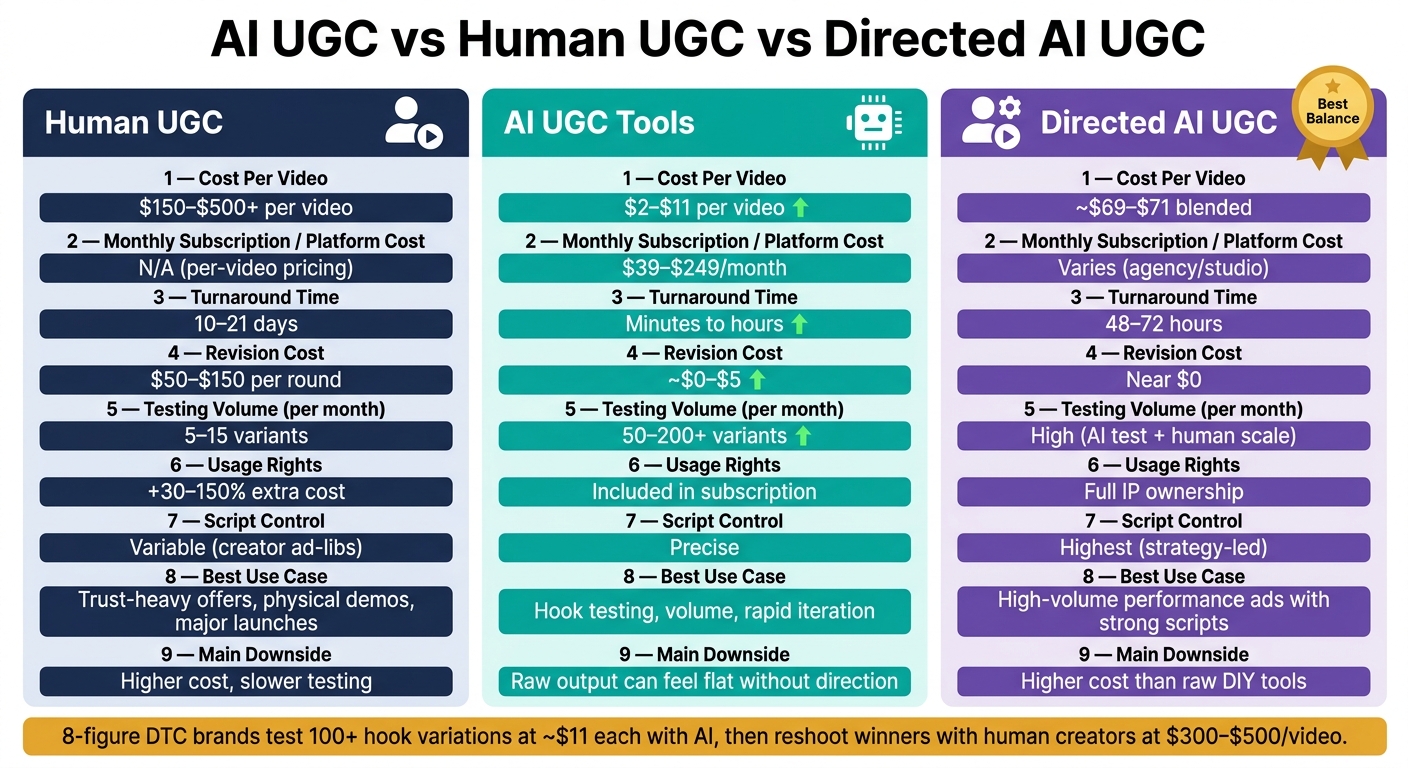
AI tools cost less at the start, but that doesn't always mean they cost less in practice. Once you add usage rights, revisions, and the amount of testing most brands need, the sticker price stops telling the whole story. Human UGC creators usually charge $150–$500 per video, while AI UGC subscriptions often land between $39–$249 per month and can bring finished-asset cost down to about $2–$11.
What drives the real cost of UGC ads over time
The base fee is just one part of the bill. Usage rights, shipping, whitelisting, and briefing time can push a "$200 video" to $350–$700 all-in. Then come revisions. With human creators, each round can cost $50–$150, while AI edits are often close to $0–$5.
The bigger issue is testing volume. Most video ads wear out within 7–10 days, and only 5%–10% of creatives turn into winners. That's where the math changes fast. Testing 30 creatives per month costs about $5,910–$9,000 with human creators, compared with $159–$600 with AI tools.
That shift - from tool price to winning-creative cost - is where AI UGC starts to make sense. It gives brands more swings before they put serious money behind one ad. A common playbook among 8-figure DTC brands is simple: use AI to test 100+ hook variations at roughly $11 each, then bring in real creators to re-shoot only the winners for $300–$500 per video.
Comparison table: human UGC, AI UGC tools, and directed AI UGC
| Human UGC | AI UGC Tools | Directed AI UGC | |
|---|---|---|---|
| Cost per video | $150–$500+ | $2–$11 | ~$69–$71 blended |
| Turnaround | 10–21 days | Minutes to hours | 48–72 hours |
| Script control | Variable (creator ad-libs) | Precise | High (strategy-led) |
| Revision cost | $50–$150/round | ~$0–$5 | Near $0 |
| Usage rights | 30%–150% extra | Included in subscription | Full IP ownership |
| Testing volume | 5–15 variants/month | 50–200+ variants/month | High (AI test, human scale) |
| Creative consistency | Hard (creator turnover) | 100% (saved avatars) | High (proven hooks) |
| Founder involvement | High (sourcing, briefing) | Low (script to video) | Moderate (strategy-led) |
Directed AI UGC sits in the middle. You get AI speed and low revision cost, but with human scripting and direction layered on top. That keeps testing lean while making the output feel more like an ad built to convert, not just a video generated from a prompt.
Cost only matters if the format fits the channel. Next: where AI UGC works best, where it misses, and how to script it.
Where AI UGC works, where it falls short, and how to script it
When AI UGC works best for ecommerce and paid social
AI UGC tends to work best when speed, testing volume, and tight message control matter more than lived experience. That makes it a strong match for supplements, skincare, digital products, app installs, and impulse buys under $40.
It’s especially useful for evergreen prospecting, retargeting ads that handle objections, seasonal promos, and hook testing. Brands running 15+ creative variants have cut time-to-winning-creative from 28 days to 9 days.
On paid social, content that obviously looks like an ad often gets skipped. AI UGC helps because you can turn around new angles fast and keep testing before fatigue sets in.
Seasonal campaigns are another good use case. Human production often moves too slowly for short promo windows, while AI UGC can be generated in minutes.
When human-shot UGC still has an edge
Human-shot UGC still comes out ahead when physical credibility matters most. Small hand movements and tactile details, like unscrewing a cap, applying serum, or showing luxury fabrics and footwear, are still tough for AI to pull off in a way that feels natural.
Use human-shot UGC for finance, legal, medical-adjacent products, founder stories, brand missions, and major launches.
Here’s the split to use:
| Feature | Human UGC | Raw AI UGC | Directed AI UGC |
|---|---|---|---|
| Trust level | Highest (lived experience) | Lower (can feel synthetic) | High (research-backed realism) |
| Complex demos | Strong | Weak | Moderate |
| Speed | 7–21 days | Minutes | Hours to days |
| Script control | Low | High | Highest |
| Best use | Hero content, high-trust niches, complex demos | Rapid hook testing and volume | High-volume performance ads |
Once you know where AI UGC belongs, the next move is simple: write a script that sounds like something a person would actually say and gets to the point fast.
A simple script framework for higher-converting AI UGC ads
The script does most of the heavy lifting. Write for speech, not page copy. That means contractions, filler words, and incomplete sentences are fair game. Better scripts also cut revision cycles and reduce test costs.
Use a three-beat structure:
| Beat | Time | Visual | Spoken line | Caption text |
|---|---|---|---|---|
| Hook | 0–7s | Avatar holds product to camera, reacts to the problem | "I stopped wasting money on [problem]... I tried everything, but nothing worked." | STOP WASTING MONEY |
| Demo | 7–20s | Show the product in action or results | "Then I found [product]. Here's what changed." | Product |
| CTA | 20–25s | Avatar points to the link | "Tap the link to see the product." | TAP THE LINK |
If you want to know what’s driving results, keep most of the ad steady and test just a few variables. A clean setup is to test 3 hook variants - problem-first, bold claim, and question - against 2 offer structures, while leaving the demo and CTA unchanged.
Ads that show human faces in the first frame retain 38% more viewers through the 3-second mark, so put the avatar on screen right away. Keep the motion simple too. Unboxing, applying, and pointing tend to work best. Tiny product details are still where the uncanny valley shows up fast.
From here, the real choice is DIY generator or directed production.
DIY tools vs. done-for-you AI UGC production: examples and next steps
How to choose between a DIY AI UGC generator and a studio partner
DIY tools in the $39–$249/month range usually give you the production parts: avatars, voice, lip-sync, and basic editing. What they don’t give you is strategy, scripting, or revision cycles. So even with the tool in place, someone on your team still needs to handle those jobs.
The choice usually comes down to two things: your monthly ad spend and how much time your team can put into this.
Here’s a simple rule of thumb based on spend:
| Monthly Ad Spend | Recommended Path | What You're Optimizing For |
|---|---|---|
| Under $3,000 | DIY tools | Hook testing and research |
| $3,000–$10,000 | DIY tools + freelance editor | Systematic test matrix |
| Over $10,000 | Studio partner | Programmatic scaling and rotation |
If you’re spending less than $3,000/month, DIY tools often make sense. They’re a low-cost way to test hooks and figure out what angle gets attention.
In the $3,000–$10,000/month range, DIY plus a freelance editor can be a smart middle ground. You still keep costs in check, but you also get help building a more organized testing system.
Once you’re over $10,000/month, a studio partner usually becomes the better path. At that point, the issue isn’t just making more ads. It’s managing rotation, output, and performance without your team getting buried in production work.
Directed production covers the whole process end to end: concept, script, generation, editing, color, sound, and final delivery.
How brands can use AI UGC across the funnel
After you choose the production path, the next step is matching the format to the buyer stage.
| Campaign Type | Funnel Stage | Recommended Format |
|---|---|---|
| Product Launch | TOF | Problem/Solution or POV |
| Retargeting | MOF/BOFU | Testimonials or Comparison/Versus |
| BOFU Discount | BOFU | Direct-to-camera with hard CTA |
| Upsell Content | BOFU | Routine/Day-in-the-life |
For product launches, problem/solution and POV formats are a good fit for Reels and TikTok. They work well at the top of the funnel because they introduce the product through a clear pain point or a fast opinion-driven angle.
For retargeting, testimonials and comparison-style ads fit the consideration stage and BOFU campaigns. By then, the viewer already knows who you are. They need a push, not a long intro.
At the bottom of the funnel, direct-to-camera with a hard CTA is often the clearest choice. It’s direct. It tells the viewer what to do next. No fluff.
For upsells, routine or day-in-the-life content can work well because it shows how the product fits into daily use.
One more thing matters here: keep the focus on the product, not the avatar. Think of the avatar as support, not the star. Use mostly product footage and B-roll, and keep the AI avatar limited.
Conclusion: the simplest way to think about AI UGC ads
AI UGC works best as a testing layer, not as a stand-in for strategy.
Tools in the $39–$249/month range can create 27 unique ad combinations from one product URL with a 3×3×3 hook-body-CTA matrix. That gives you a fast way to test angles before putting more ad dollars behind them.
That said, the hard part doesn’t disappear. The script still needs to sound like a person. The avatar still needs to fit your audience. And someone still has to look at the numbers and decide what stays and what gets cut.
AI UGC is mostly about getting more testable hooks in market before you scale spend. If you want to skip some of the back-and-forth and start with directed AI UGC built around your offer, get in touch with Elizaveta Tskhovrebova.
FAQs
How realistic do AI UGC ads need to look to convert?
Not perfect - and that’s often the point. AI UGC ads tend to work better when they feel a little rough around the edges. Think phone-shot clips that look like something a friend would send, not a polished studio ad that sets off someone’s mental ad filter.
Lean into a casual feel: natural light, lived-in spaces, and small flaws like slightly off-center framing or a bit of blur. That stuff can help the ad feel more like normal content.
But the script does most of the heavy lifting. How it sounds matters. Contractions, filler words, and loose, informal phrasing often beat polished marketing copy.
When should I use AI UGC instead of human UGC?
Use AI UGC when speed matters, you need a lot of tests, and you want to keep costs down.
It’s a good fit when you need to:
- make lots of hook variations fast
- test across different demographics or languages
- hit tight deadlines
It also works well for product demos, feature showcases, and top-of-funnel reach.
Use human UGC when the job calls for real emotional storytelling, hands-on product interaction, or the highest level of trust for high-consideration purchases.
Can AI UGC ads work for higher-ticket products?
Yes. AI UGC ads can work well for higher-ticket products, especially in SaaS, services, and products with a learning curve.
They tend to work best when buyers need a clear explanation or a simple demo to understand how something works and why it matters. That extra context helps people remember the main benefits instead of skimming past them.
They can also do a solid job with trust-building. Testimonial-style ads that follow a problem → discovery → result flow often make the message feel more grounded and easier to relate to, which can help with social proof.
Need video like this for your brand?
UGC, commercials, explainers and cinematic — directed with AI, finished like a studio.
Start a project →