AI Commercials & Brand Films: Cinematic Quality on a Startup Budget
_You can now make a polished AI commercial for about _$2,000 to $6,000_ instead of spending $15,000+* on a standard live shoot._* But the tool alone does not make it look like a brand film. The result depends on direction, editing, color, sound, and strict quality control.
Here’s the short version:
- AI cuts production costs by removing crew, locations, travel, and much of the shoot-day overhead.
- Human work still matters most in the parts AI misses: shot planning, visual consistency, brand accuracy, and audio finish.
- AI is best for launch spots, hero ads, and brand films with big visuals or hard-to-shoot scenes.
- AI is weaker for testimonials, live demos, and celebrity-led videos where exact likeness and continuity matter.
- Timelines are shorter: about 2 to 14 days for AI-led production vs. 4 to 12 weeks for a standard commercial.
- Versioning is cheaper: brands can test 20 to 50 variants of one idea without paying for reshoots.
- Good AI ads are built shot by shot, not from one prompt.
If I had to sum up the whole article in one line, it would be this: AI makes cinematic ad production cheaper, but not automatic.
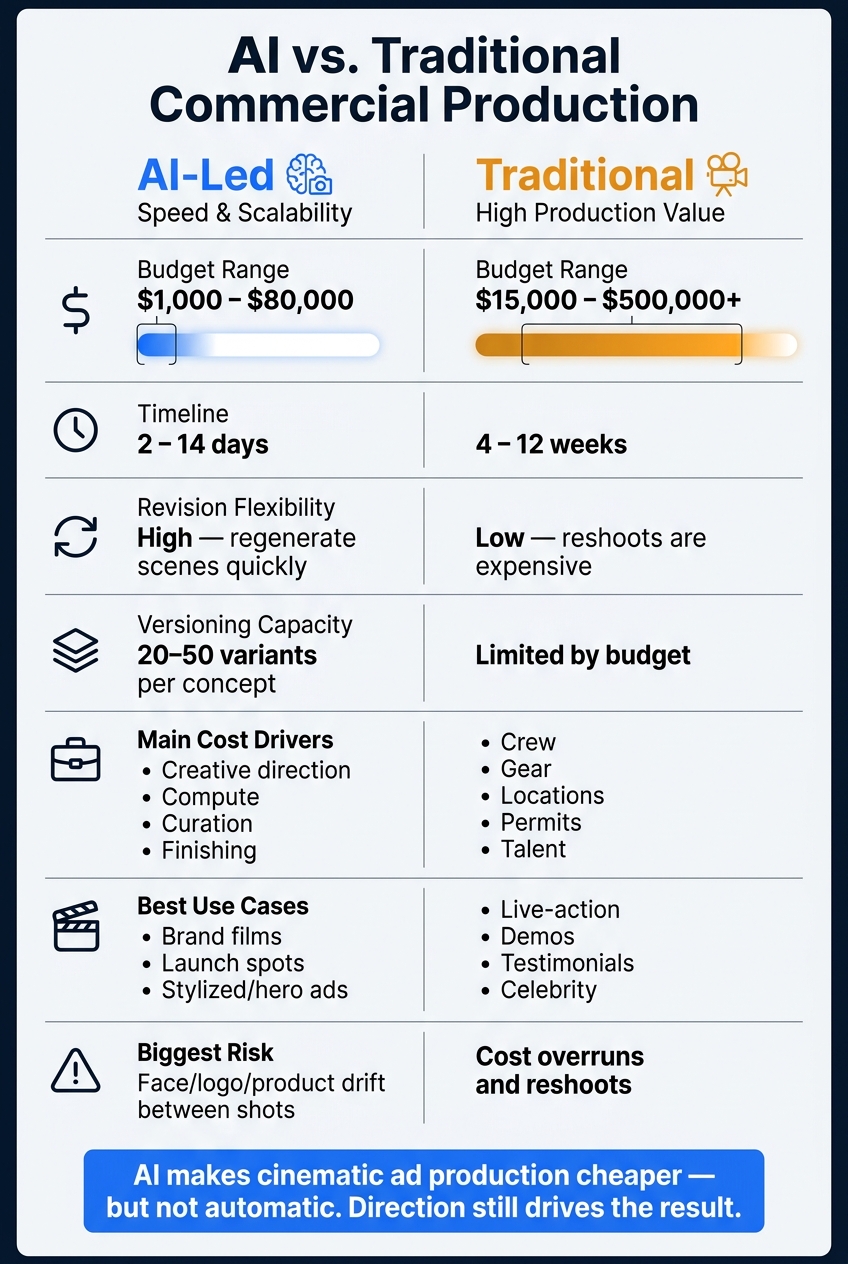
AI vs. Traditional Commercial Production: Cost, Timeline & Quality Compared
Quick comparison
| Criteria | Standard Commercial | AI-Led Commercial |
|---|---|---|
| Typical budget | $15,000 to $500,000+ | $1,000 to $80,000 |
| Common timeline | 4 to 12 weeks | 2 to 14 days |
| Main cost drivers | Crew, gear, locations, permits, talent | Direction, compute, clip selection, post |
| Revision cost | High | Lower |
| Best use cases | Live-action scenes, demos, testimonials | Brand films, launch spots, stylized ads |
| Biggest risk | Cost and reshoots | Drift in faces, products, logos, and audio |
What this means for you is simple: if you want a premium look on a startup budget, AI can get you there - but only with a directed process from brief to final export.
sbb-itb-f51e864
What AI commercials can do now - and where human direction still matters
AI commercial production now runs on a directed workflow, not one magic prompt. Teams use different models for different shots, then stitch them into :15, :30, or :60 spots, brand films, and social cutdowns in the formats a campaign calls for. That setup only works when each shot is directed with intent, not simply generated and dropped in.
What AI handles well: brand worlds, product environments, and rapid versioning
AI starts to make sense in commercial production when a brand wants visuals that would cost a lot - or be a headache - to shoot in the real world. Photorealistic product environments, surreal transitions, camera fly-throughs, and stylized brand worlds are now possible at a small share of the cost of a standard shoot. A sequence that once needed a full location build plus a VFX budget can now come together much faster.
The bigger day-to-day win is rapid versioning. AI-led pipelines can turn out 20–50 variants of one concept, including different openers, captions, or B-roll cuts, at low extra cost. That sounds simple on paper. It isn't. The hard part is picking the right model for each shot and blending the outputs so the seams don't show.
Once consistency becomes the goal, the job changes. It stops being about generation and starts being about direction.
Where AI falls short: consistency, brand assets, and audio finishing
Raw AI output still has hard limits. Character consistency is the biggest one: a person's face, hair, or clothing can change from shot to shot, and that instantly breaks the sense that you're watching one story. Exact brand assets also remain tricky. Logos, product packaging, and specific brand colors can drift or come back wrong. Audio and dialogue still need human finishing too.
That's where direction and post-production earn their keep. Color grading, sound design, motion graphics, and final QC are what turn a pile of generated clips into something that feels like a finished commercial. Moonshot's AI-generated film for Tata Consumer Products shows this clearly: the team brought in a traditional cinematographer to fix lighting and color inconsistencies the model couldn't resolve.
AI can produce the raw material. Human direction is what makes it feel like an ad. And those weak spots - consistency, asset accuracy, and finishing - are still the line between cinematic AI video and slop.
Cinematic AI video vs. low-effort AI output
Cinematic quality comes from craft, not prompts. Generic AI output can put motion on a screen, but that alone doesn't protect how people see your brand. That's the line between raw AI video and a brand film.
What makes an AI commercial look and feel cinematic
A cinematic ad feels directed. Framing is intentional. Lens depth looks believable. Lighting falls off the way you'd expect in a real scene, instead of looking flat or random.
Just as important, each shot needs a job. It should move the story forward, not just prove that something is moving. In most cases, a strong spot uses 8 to 15 shots, opens fast, and ends on a clear brand moment.
Sound is the last layer that makes it click. That usually means custom music, audio that's properly leveled, and a directed voiceover that fits the brand's tone.
Those details don't happen by accident. They hold up only when the pipeline is directed from the brief all the way to the final cut.
How a directed pipeline avoids generic results
A directed pipeline starts before any generation begins. First come moodboards, reference frames, and a shot list. Character and product reference sheets lock identity early, which helps stop features from drifting between cuts. That's one of the most common weak spots in low-effort work.
Script approval should happen before a single clip is generated. From there, the team makes many options, keeps only the shots that match the brief, and finishes the piece in post. Color grading, grain, stabilization, and sound finishing are what make the final video feel finished instead of half-baked.
A studio approach treats AI like one instrument in a full production process, not the whole process.
"A team that drops $100 in credits and posts the raw render gets a $100 result. A team that treats it like a real production gets a real production." - Diego Cipion, Founder, Cipion Marketing
The table below shows where these two paths split:
| Stage | Cinematic AI Commercials | Low-effort AI Outputs |
|---|---|---|
| Pre-production | Brief, shot list, moodboards, and reference sheets | Single text prompt, no planning |
| Consistency | Locked character and product identity across every shot | Features and lighting drift between cuts |
| Editing | Professional editorial, color grading, and film grain | Raw renders stitched together without post-processing |
| Audio | Custom sound design, licensed music, directed VO | Generic stock music, out-of-the-box AI voice settings |
| Brand fit | Tuned to brand colors, typography, and guidelines | Generic AI look that could belong to any brand |
| Viewer perception | Reads as professionally produced | Feels synthetic or off |
That gap in craft also shows up in the budget.
AI commercial production cost vs. traditional commercial cost
Where the money goes: traditional production vs. AI-led production
The gap in craft shows up in the budget too. With a standard commercial shoot, most of the money goes into physical production: crew, gear rentals, location fees, permits, talent, wardrobe, catering, and travel. Even a basic live-action commercial usually starts at $15,000.
AI-led production changes that mix. Instead of paying for a set, a crew, and travel days, brands spend more on creative direction, concept development, model selection, compute, and curation.
Kalshi’s June 2025 NBA Finals ad is a good example. It reportedly cost about $2,000, and the director generated 300 to 400 clips to find 15 usable segments. That tells you a lot about how AI budgets work: less money goes to physical execution, but a lot still goes into taste, judgment, and cleanup.
Budget ranges and what brands can expect at each level
For startups and smaller brands, social-first spots in the 15–30 second range often start at $500 to $2,500. Hero ads and short brand films often fall around $5,000 to $20,000. Premium 60-second, TV-commercial-style work can hit $25,000 to $80,000+. Even then, that’s still well under the $150,000 to $500,000 range that’s common in agency-led live-action production.
Lower cost on its own doesn’t mean much. What matters is that the finished ad can still feel cinematic when the direction and post work are done well.
| Traditional Live-Action Commercial | AI-Led Commercial Production | |
|---|---|---|
| Budget Range | $15,000 – $500,000+ | $1,000 – $80,000 |
| Timeline | 4 – 12 weeks | 2 – 14 days |
| Revision Flexibility | Low - reshoots are expensive | High - regenerate scenes quickly |
| Major Cost Drivers | Crew, locations, gear, permits, talent | Creative direction, model usage, curation, finishing |
| Visual Ambition | Limited by physical budget and VFX costs | High - impossible or fantasy scenes cost the same as realistic ones |
That kind of flexibility matters most when a brand needs launch spots, brand films, or hero ads and can’t wait months or burn cash on reshoots.
Use cases and how to commission an AI brand film
Where AI commercial production fits best: launch spots, brand films, and hero ads
AI works best when a brand wants premium scale without the cost of a live shoot. It’s not the right move for every kind of video. But for projects where speed, visual range, and room to test ideas matter most, it can be a very strong option.
Cost savings matter most when the brief calls for scale, speed, or bold visuals more than live-action realism.
| Use Case | Best For | Why It Fits |
|---|---|---|
| Product Launch | Category entry, visual scale | High-concept environments and fast concept testing |
| Brand Film | Worldview, brand positioning | Cinematic storytelling without literal product-demo constraints |
| Hero Ad | Paid social hooks | Fast iteration and aspect-ratio flexibility |
AI is a weaker fit for founder testimonials, hands-on product demos, and live celebrity endorsements.
Once the use case is set, the next step is a directed approval process that locks the look before motion starts.
How the directed pipeline runs from brief to final delivery
The workflow starts with a business brief, then moves into script, style frames, motion generation, and final finishing. The big checkpoint comes early: style frames get locked first. Client approval happens on stills before any motion is made, which helps avoid expensive surprises.
From there, AI generation starts, with different models used for different shot types. The raw output then goes through cinematic finishing: editing, color grading, and sound design. Final delivery includes exports in 16:9, 9:16, and 1:1, so the asset is ready for YouTube, TikTok, paid social, and website hero placements from day one.
The savings come from removing physical production overhead, not from cutting direction. That’s the key point. The edge comes from direction, not the tool, and that direction needs to show up at every stage, from brief through finishing.
How to buy premium AI video without wasting budget
The buyer’s job is simple: lock scope early so the budget goes into direction and finishing, not rework.
Treat AI production like a real production. Budget for the brief, direction, iteration, and finishing. Plan for exports in 16:9, 9:16, and 1:1 from the start. Briefing for all ratios upfront costs far less than reformatting later. Define usage rights before production begins too, since paid media licenses differ from organic-only use.
Ready to commission a premium AI commercial or brand film? Contact Elizaveta Tskhovrebova for a custom brief and quote.
FAQs
How do I know if my project is a good fit for AI commercial production?
AI commercial production makes sense when you need cinematic, broadcast-quality visuals but don’t have the budget for a full shoot. It’s a smart option for fast turnarounds, high-volume testing, and big visual ideas that would cost a lot to film the old-school way.
Traditional production is often the better pick for real product demos, live-action celebrity talent, and longer, more personal pieces with people speaking on camera. A lot of brands land somewhere in the middle and use a hybrid approach.
What should I prepare before commissioning an AI brand film?
Prepare the business context first, not the technical specs. That means your brand story, product positioning, campaign goals, target audience, and the platforms where the content will run.
You should also have your brand assets ready, like logos and color palettes. Think of it this way: you bring the business know-how, and your production partner turns that into a script and visual plan.
It also helps to go in ready for a discovery process. You may need to talk through different versions, opening hooks, or emotional tones to find what fits best.
How many revision rounds should I expect in an AI-led video project?
Revision rounds are usually part of the workflow, not handled like expensive reshoots.
In most cases, the process narrows choices over a few rounds of generation. A team might start with a rough round that includes several versions of each shot. Then comes a refined round, followed by a final pick.
Because the changes happen digitally, revisions are often faster and less expensive than in traditional production. In many cases, they take hours, not days.
Need video like this for your brand?
UGC, commercials, explainers and cinematic — directed with AI, finished like a studio.
Start a project →